


 Cart
Cart
 sales@molnova.com


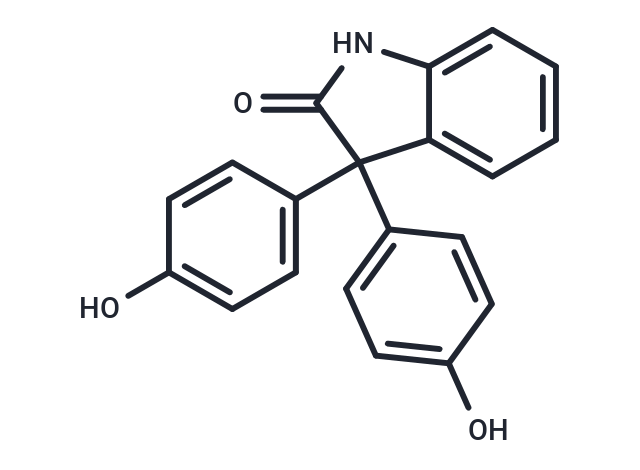
Oxyphenisatine
CAS No. 125-13-3
Oxyphenisatine( —— )
Catalog No. M36351 CAS No. 125-13-3
Oxyphenisatine (Oxyphenisatin), along with related bisacodyl, sodium picosulfate, and phenolphthalein, isa precursor of oxyphenisatine, which has anticancer activity.
Purity : >98% (HPLC)
 COA
Datasheet
HNMR
HPLC
MSDS
Handing Instructions
COA
Datasheet
HNMR
HPLC
MSDS
Handing Instructions
| Size | Price / USD | Stock | Quantity |
| 10MG | 28 | In Stock |


|
| 500MG | Get Quote | In Stock |
|
| 1G | Get Quote | In Stock |
|
Biological Information
-
Product NameOxyphenisatine
-
NoteResearch use only, not for human use.
-
Brief DescriptionOxyphenisatine (Oxyphenisatin), along with related bisacodyl, sodium picosulfate, and phenolphthalein, isa precursor of oxyphenisatine, which has anticancer activity.
-
DescriptionOxyphenisatine (Oxyphenisatin) is a laxative. Oxyphenisatin acetate is the pro-agent of oxyphenisatin with anticancer activity.
-
In VitroOxyphenisatin has been shown to have antiproliferative activity. Oxyphenisatin acetate (OXY, NSC 59687) is the pro-drug of oxyphenisatin. OXY inhibits the growth of the breast cancer cell lines MCF7, T47D, HS578T, and MDA-MB-468 (IC50=0.8, 0.6, 2.1, 1.8 μM). This effect is associated with selective inhibition of translation accompanied by rapid phosphorylation of the nutrient sensing eIF2α kinases, GCN2 and PERK.
-
In VivoToxicity studies demonstrate that mice tolerate IP administration of OXY at 300 mg/kg once daily or 200 mg/kg twice daily. Administration of OXY at 300 mg/kg IP once daily for 10 days results in significantly smaller tumors from day 33 to day 52.
-
Synonyms——
-
PathwayOthers
-
TargetOther Targets
-
RecptorOthers
-
Research Area——
-
Indication——
Chemical Information
-
CAS Number125-13-3
-
Formula Weight317.34
-
Molecular FormulaC20H15NO3
-
Purity>98% (HPLC)
-
SolubilityIn Vitro:?DMSO : 250 mg/mL (787.80 mM; Ultrasonic )
-
SMILESOc1ccc(cc1)C1(C(=O)Nc2ccccc12)c1ccc(O)cc1
-
Chemical Name——
Shipping & Storage Information
-
Storage(-20℃)
-
ShippingWith Ice Pack
-
Stability≥ 2 years
Reference
1. Morrison BL, et al. Oxyphenisatin acetate (NSC 59687) triggers a cell starvation response leading to autophagy, mitochondrial dysfunction, and autocrine TNFα-mediated apoptosis. Cancer Med. 2013 Oct;2(5):687-700.?
molnova catalog



related products
-
Perillyl alcohol
Perillyl Alcohol is a naturally occurring monoterpene related to limonene with antineoplastic activity.
-
Monopotassium glutam...
Monopotassium glutamate can be used in foods as a flavor enhancer.
-
COH-SR4 (Mitochondri...
SR4 is a uncoupler of mitochondrial oxidative phosphorylation. SR4 modulating amp-dependent kinase (ampk)-mammalian target of rapamycin (mtor) signaling, and inhibiting proliferation of hepg2 hepatocarcinoma cellsSR4 is a novel mitochondrial uncoupler with anti-obesity and anti-diabetic properties.?
