


 Cart
Cart
 sales@molnova.com


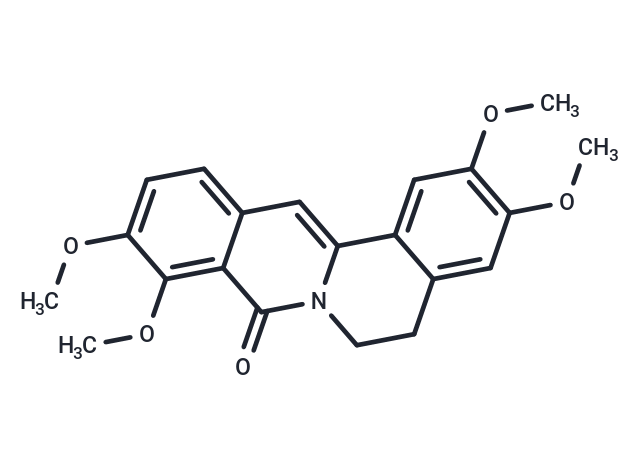
Oxypalmatine
CAS No. 19716-59-7
Oxypalmatine( —— )
Catalog No. M37729 CAS No. 19716-59-7
Oxypalmatine (8-Oxypalmatine) is a berberine-type alkaloid isolated from Phellodendron amurense that regulates breast cancer cell proliferation and apoptosis by inhibiting PI3K/AKT signaling and its efficacy in breast cancer-like organs.
Purity : >98% (HPLC)
 COA
Datasheet
HNMR
HPLC
MSDS
Handing Instructions
COA
Datasheet
HNMR
HPLC
MSDS
Handing Instructions
| Size | Price / USD | Stock | Quantity |
| 2MG | 97 | Get Quote |


|
| 5MG | 126 | Get Quote |
|
| 10MG | 202 | Get Quote |
|
| 500MG | Get Quote | Get Quote |
|
| 1G | Get Quote | Get Quote |
|
Biological Information
-
Product NameOxypalmatine
-
NoteResearch use only, not for human use.
-
Brief DescriptionOxypalmatine (8-Oxypalmatine) is a berberine-type alkaloid isolated from Phellodendron amurense that regulates breast cancer cell proliferation and apoptosis by inhibiting PI3K/AKT signaling and its efficacy in breast cancer-like organs.
-
DescriptionOxypalmatine is isolated from Phellodendron amurense.
-
In Vitro——
-
In Vivo——
-
Synonyms——
-
PathwayApoptosis
-
TargetApoptosis
-
RecptorApoptosis
-
Research Area——
-
Indication——
Chemical Information
-
CAS Number19716-59-7
-
Formula Weight367.4
-
Molecular FormulaC21H21NO5
-
Purity>98% (HPLC)
-
SolubilityIn Vitro:?DMSO : 33.33 mg/mL (90.72 mM; Ultrasonic (<60°C)
-
SMILESCOc1ccc2cc3-c4cc(OC)c(OC)cc4CCn3c(=O)c2c1OC
-
Chemical Name——
Shipping & Storage Information
-
Storage(-20℃)
-
ShippingWith Ice Pack
-
Stability≥ 2 years
Reference
1. Min YD, et al. Isolation of limonoids and alkaloids from Phellodendron amurense and their multidrug resistance (MDR) reversal activity. Arch Pharm Res. 2007;30(1):58-63.?
molnova catalog



related products
-
Nebularine
Nebularine (9-(beta-D-Ribofuranosyl)-9H-purine) is a purine nucleoside analog with a broad spectrum of antitumor activity, targeting inert lymphoid malignancies and inducing apoptosis.
-
Necrostatin-7
Necrostatin-7 (Necrostatin 7) is an inhibitor of necrotic apoptosis with cardioprotective effects, inhibits RANK-NFATc1 signaling, and attenuates macrophage differentiation into osteoblasts.
-
Diethyl phthalate
Diethyl phthalate is a endocrine disrupter affecting the apoptotic system in PC12 cells. Diethyl phthalate is widely used in many plastics and personal care products.
