


 Cart
Cart
 sales@molnova.com


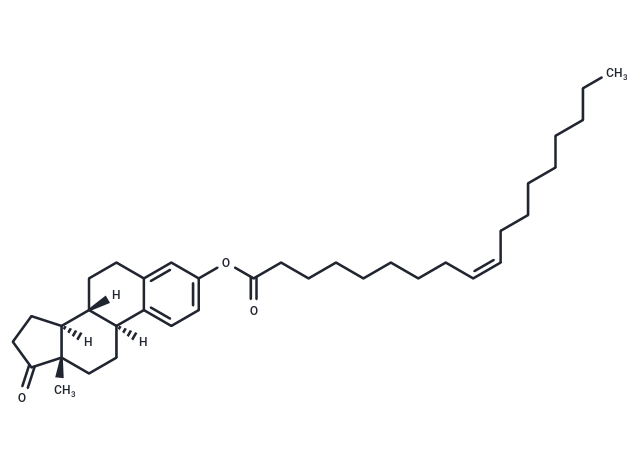
Oleoylestrone
CAS No. 180003-17-2
Oleoylestrone( —— )
Catalog No. M34356 CAS No. 180003-17-2
Oleoylestrone (MP-101) is present in plasma and adipose tissue, has potential antioxidant effects, induces loss of body fat in rats, and can be used for weight loss.
Purity : >98% (HPLC)
 COA
Datasheet
HNMR
HPLC
MSDS
Handing Instructions
COA
Datasheet
HNMR
HPLC
MSDS
Handing Instructions
| Size | Price / USD | Stock | Quantity |
| 2MG | 445 | Get Quote |


|
| 5MG | 686 | Get Quote |
|
| 10MG | 938 | Get Quote |
|
| 25MG | 1398 | Get Quote |
|
| 50MG | 1822 | Get Quote |
|
| 500MG | Get Quote | Get Quote |
|
| 1G | Get Quote | Get Quote |
|
Biological Information
-
Product NameOleoylestrone
-
NoteResearch use only, not for human use.
-
Brief DescriptionOleoylestrone (MP-101) is present in plasma and adipose tissue, has potential antioxidant effects, induces loss of body fat in rats, and can be used for weight loss.
-
DescriptionOleoylestrone (MP-101) is present in plasma and adipose tissue, has potential antioxidant effects, induces loss of body fat in rats, and can be used for weight loss.
-
In Vitro——
-
In Vivo——
-
Synonyms——
-
PathwayOthers
-
TargetAntioxidant
-
RecptorAntioxidant
-
Research Area——
-
Indication——
Chemical Information
-
CAS Number180003-17-2
-
Formula Weight534.81
-
Molecular FormulaC36H54O3
-
Purity>98% (HPLC)
-
Solubility——
-
SMILESC[C@@]12[C@]([C@]3([C@@](C=4C(CC3)=CC(OC(CCCCCCC/C=C\CCCCCCCC)=O)=CC4)(CC1)[H])[H])(CCC2=O)[H]
-
Chemical Name——
Shipping & Storage Information
-
Storage(-20℃)
-
ShippingWith Ice Pack
-
Stability≥ 2 years
Reference
molnova catalog



related products
-
L-Carnosine
L-Carnosine is is an antioxidant naturally found in skeletal muscle brain tissue. It has the potential to suppress many of the biochemical changes that accompany aging.
-
Gallein
Gallein is a small molecule inhibitor of Gβγ activity.
-
Neochlorogenic acid ...
Neochlorogenic acid methyl ester is derived from Artemisia capillaris and black chokeberry (Aronia melanocarpa) fruits. Neochlorogenic acid methyl ester shows weak anti-HBV activity, antioxidant and quinone reductase activity with CD of 6.7 μM.
