


 Cart
Cart
 sales@molnova.com


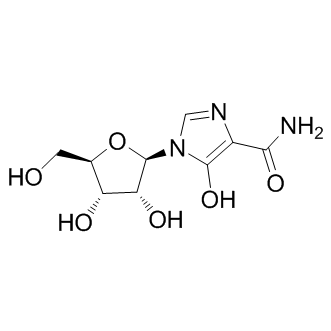
Mizoribine
CAS No. 50924-49-7
Mizoribine( NSC-289637 | HE-69 )
Catalog No. M14751 CAS No. 50924-49-7
An immunosuppressive agent that inhibits the proliferation of lymphocytes selectively, via inhibition of IMPDH.Rheumatoid ArthritisApproved
Purity : >98% (HPLC)
 COA
Datasheet
HNMR
HPLC
MSDS
Handing Instructions
COA
Datasheet
HNMR
HPLC
MSDS
Handing Instructions
| Size | Price / USD | Stock | Quantity |
| 10MG | 41 | In Stock |


|
| 25MG | 55 | In Stock |
|
| 50MG | 87 | In Stock |
|
| 100MG | 149 | In Stock |
|
| 200MG | 194 | In Stock |
|
| 500MG | Get Quote | In Stock |
|
| 1G | Get Quote | In Stock |
|
Biological Information
-
Product NameMizoribine
-
NoteResearch use only, not for human use.
-
Brief DescriptionAn immunosuppressive agent that inhibits the proliferation of lymphocytes selectively, via inhibition of IMPDH.Rheumatoid ArthritisApproved
-
DescriptionAn immunosuppressive agent that inhibits the proliferation of lymphocytes selectively, via inhibition of IMPDH.Rheumatoid Arthritis Approved(In Vitro):Mizoribine, isolated from culture medium of the mold Eupenicillium brefeldianum M-2166, acts as an immunosuppressant which exerts its effects without severe side effects.Mizoribine is an inosine-5′-monophosphate dehydrogenase (IMPDH) inhibitorused for renal transplantation, autoimmune diseases and steroid-resistant nephrotic syndrome .(In Vivo):Mizoribine suppresses collagen-induced arthritis. Mizoribine (10, 20 and 50 mg/kg; Administered orally 5 days a week for 12 weeks) reduces the arthritis score in a dose-dependent fashion, showing significant suppression, even at a dose of 10 mg/kg.
-
In VitroMizoribine, isolated from culture medium of the mold Eupenicillium brefeldianum M-2166, acts as an immunosuppressant which exerts its effects without severe side effects.Mizoribine is an inosine-5′-monophosphate dehydrogenase (IMPDH) inhibitorused for renal transplantation, autoimmune diseases and steroid-resistant nephrotic syndrome .
-
In VivoMizoribine suppresses collagen-induced arthritis. Mizoribine (10, 20 and 50 mg/kg; Administered orally 5 days a week for 12 weeks) reduces the arthritis score in a dose-dependent fashion, showing significant suppression, even at a dose of 10 mg/kg. Animal Model:Male DBA/1 J mice with collagen-induced arthritisDosage:10, 20 and 50 mg/kg Administration:Administered orally 5 days a week for 12 weeks Result:Showed dose-dependency of the suppressive effect.
-
SynonymsNSC-289637 | HE-69
-
PathwayOthers
-
TargetOther Targets
-
Recptormonophosphatesynthetase
-
Research AreaInflammation/Immunology
-
IndicationRheumatoid Arthritis
Chemical Information
-
CAS Number50924-49-7
-
Formula Weight259.216
-
Molecular FormulaC9H13N3O6
-
Purity>98% (HPLC)
-
SolubilityDMSO: ≥ 35 mg/mL
-
SMILESO=C(C1=C(O)N([C@@H]2O[C@H](CO)[C@@H](O)[C@H]2O)C=N1)N
-
Chemical Name1H-Imidazole-4-carboxamide, 5-hydroxy-1-β-D-ribofuranosyl-
Shipping & Storage Information
-
Storage(-20℃)
-
ShippingWith Ice Pack
-
Stability≥ 2 years
Reference
molnova catalog



related products
-
BAD (103 - 127), hum...
BAD (103 - 127), human
-
Sari 59-801
Sari 59-801 is a novel, orally effective hypoglycemic compound that appears to act largely by stimulation of insulin release. SARI-59-801 was more potent in producing hypoglycemia (ED25 = 47 mg/kg) than their lean littermates (ED25 = 131 mg/kg).
-
Theaflavin-3'-Gallat...
Theaflavin-3'-gallate, act as prooxidants and induce oxidative stress, with carcinoma cells more sensitive than normal fibroblasts.
