


 Cart
Cart
 sales@molnova.com


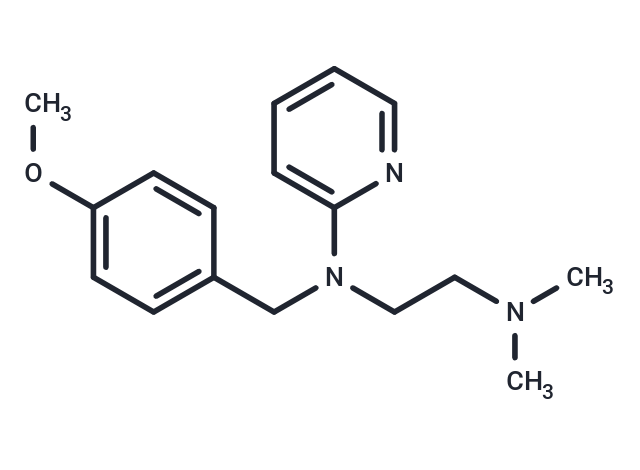
Mepyramine
CAS No. 91-84-9
Mepyramine( —— )
Catalog No. M34003 CAS No. 91-84-9
Mepyramine is a histamine H1 antagonist. It has mild hypnotic properties and some local anesthetic action and is used for allergies both parenterally and locally.
Purity : >98% (HPLC)
 COA
Datasheet
HNMR
HPLC
MSDS
Handing Instructions
COA
Datasheet
HNMR
HPLC
MSDS
Handing Instructions
| Size | Price / USD | Stock | Quantity |
| 2MG | 135 | In Stock |


|
| 5MG | 187 | In Stock |
|
| 10MG | 283 | In Stock |
|
| 25MG | 438 | In Stock |
|
| 50MG | 624 | In Stock |
|
| 100MG | 821 | In Stock |
|
| 200MG | 1098 | In Stock |
|
| 500MG | Get Quote | In Stock |
|
| 1G | Get Quote | In Stock |
|
Biological Information
-
Product NameMepyramine
-
NoteResearch use only, not for human use.
-
Brief DescriptionMepyramine is a histamine H1 antagonist. It has mild hypnotic properties and some local anesthetic action and is used for allergies both parenterally and locally.
-
DescriptionMepyramine is a histamine H1 antagonist. It has mild hypnotic properties and some local anesthetic action and is used for allergies both parenterally and locally.
-
In Vitro——
-
In Vivo——
-
Synonyms——
-
PathwayOthers
-
TargetOther Targets
-
RecptorOthers
-
Research Area——
-
Indication——
Chemical Information
-
CAS Number91-84-9
-
Formula Weight285.38
-
Molecular FormulaC17H23N3O
-
Purity>98% (HPLC)
-
Solubility——
-
SMILESN(CC1=CC=C(OC)C=C1)(CCN(C)C)C2=CC=CC=N2
-
Chemical Name——
Shipping & Storage Information
-
Storage(-20℃)
-
ShippingWith Ice Pack
-
Stability≥ 2 years
Reference
molnova catalog



related products
-
ELA-32 (human)
Potent, high affinity apelin receptor agonist (IC50 = 0.27 nM; Kd = 0.51 nM). Exhibits no binding GPR15 and GPR25. Activates the PI3K/AKT pathway and promotes self-renewal of hESCs via cell-cycle progression and protein translation. Also potentiates the TGFβ pathway, priming hESCs toward the endoderm lineage. Stimulates angiogenesis in HUVEC cells. Relaxes mouse aortic vessels. Functions as an anorexigenic hormone through activation of the AVP and CRH neurons in the PVN.
-
Lugrandoside
Lugrandoside is a novel phenylpropanoid glycoside, lugrandoside, has been isolated from the caulinary leaves of Digitalis Lutea L. and Difitalis Grandiflora Miller.
-
Scrambled TRAP Fragm...
Scrambled TRAP Fragment
