


 Cart
Cart
 sales@molnova.com


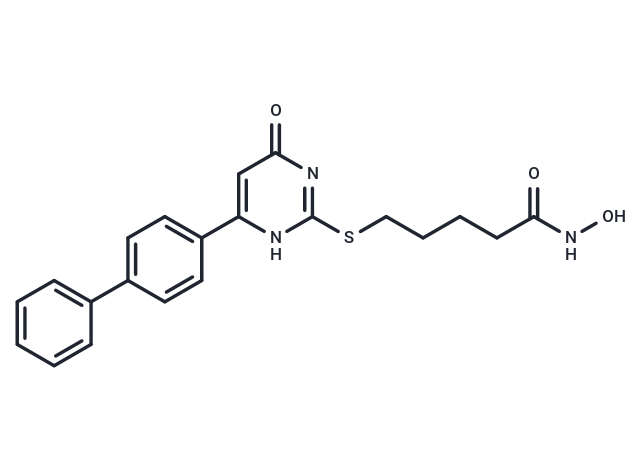
MC1742
CAS No. 1776116-74-5
MC1742( —— )
Catalog No. M34786 CAS No. 1776116-74-5
MC1742 is an inhibitor of class I histone deacetylases (HDACs; IC50s = 0.1, 0.11, 0.02, and 0.61 μM for HDAC1, -2, -3, and -8, respectively) and class IIb HDACs (IC50s = 7 and 40 nM for HDAC6 and HDAC10, respectively).
Purity : >98% (HPLC)
 COA
Datasheet
HNMR
HPLC
MSDS
Handing Instructions
COA
Datasheet
HNMR
HPLC
MSDS
Handing Instructions
| Size | Price / USD | Stock | Quantity |
| 500MG | Get Quote | Get Quote |


|
| 1G | Get Quote | Get Quote |
|
Biological Information
-
Product NameMC1742
-
NoteResearch use only, not for human use.
-
Brief DescriptionMC1742 is an inhibitor of class I histone deacetylases (HDACs; IC50s = 0.1, 0.11, 0.02, and 0.61 μM for HDAC1, -2, -3, and -8, respectively) and class IIb HDACs (IC50s = 7 and 40 nM for HDAC6 and HDAC10, respectively).
-
DescriptionMC1742 is a potent HDAC inhibitor, with IC50s of 0.1 μM, 0.11 μM, 0.02 μM, 0.007 μM, 0.61 μM, 0.04 μM and 0.1 μM for HDAC1, HDAC2, HDAC3, HDAC6, HDAC8, HDAC10 and HDAC11, respectively. MC1742 can increase acetyl-H3 and acetyl-tubulin levels and inhibits cancer stem cells growth. MC1742 can induce growth arrest, apoptosis, and differentiation in sarcoma CSC.
-
In VitroMC1742 (compound 1) (0.5 and 2 μM; 24 hours) increases acetylation in a dose-dependent manner, observable as punctuate nuclear staining of acetyl-histone H3.MC1742 (0.5, 1 and 2 μM; 24, 48 and 72 hours) significantly induces apoptosis of all CSC cultures.MC1742 (0.025-0.5 μM; 14 days) enhances bone nodule formation in a significantdose-dependent manner.Immunofluorescence Cell Line:Sarcoma cancer stem cells Concentration:0.5 and 2 μM Incubation Time:24 hours Result:Increased acetylation in a dose-dependent manner, observable as punctuate nuclear staining of acetyl-histone H3.Apoptosis Analysis Cell Line:Sarcoma cancer stem cells Concentration:0.5, 1 and 2 μM Incubation Time:24, 48 and 72 hours Result:Significantly induced apoptosis of all CSC cultures.Cell Differentiation Assay Cell Line:Sarcoma cancer stem cells Concentration:0.025, 0.05, 0.1 and 0.5 μM Incubation Time:14 days Result:Successfully enhanced bone nodule formation in a significantdose-dependent manner.
-
In Vivo——
-
Synonyms——
-
PathwayOthers
-
TargetOther Targets
-
RecptorOthers
-
Research Area——
-
Indication——
Chemical Information
-
CAS Number1776116-74-5
-
Formula Weight395.47
-
Molecular FormulaC21H21N3O3S
-
Purity>98% (HPLC)
-
SolubilityIn Vitro:?DMSO : 200 mg/mL (505.73 mM; Ultrasonic )
-
SMILESS(CCCCC(NO)=O)C=1NC(=CC(=O)N1)C2=CC=C(C=C2)C3=CC=CC=C3
-
Chemical Name——
Shipping & Storage Information
-
Storage(-20℃)
-
ShippingWith Ice Pack
-
Stability≥ 2 years
Reference
1. Di Pompo G, et al. Novel histone deacetylase inhibitors induce growth arrest, apoptosis, and differentiation in sarcoma cancer stem cells. J Med Chem. 2015;58(9):4073-4079.?
molnova catalog



related products
-
Ophiopogonanone A
Ophiopogonanone A has oxygen free radicals(OFRs) scavenging effects, it can scavenge hydroxyl radical(·OH) and hydrogen peroxide(H2O2) in vitro.
-
Bendazac L-lysine
Bendazac L-Lysine is one of agents that have been introduced for the management of cataracts, protecting the level of vision in patients, thus delaying the need for surgical intervention.
-
ETHYL 2-AMINO-4-METH...
ETHYL 2-AMINO-4-METHYL-5-PHENYLTHIOPHENE-3-CARBOXYLATE targets the prostaglandin E2 receptor EP2 subtype (human).
