


 Cart
Cart
 sales@molnova.com


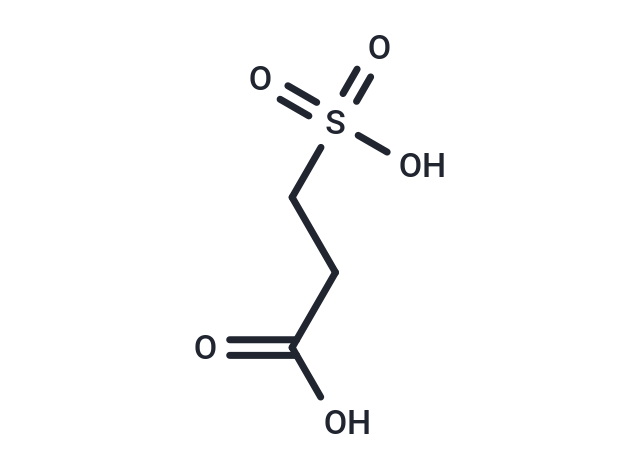
3-Sulfopropanoic acid
CAS No. 44826-45-1
3-Sulfopropanoic acid( —— )
Catalog No. M37854 CAS No. 44826-45-1
3-Sulfopropanoic acid, a major metabolite of treprostinil and its prodrug ALZ-801, is an endogenous molecule present in the cerebrospinal fluid (CSF) of AD patients that inhibits the formation of Aβ42 oligomers.
Purity : >98% (HPLC)
 COA
Datasheet
HNMR
HPLC
MSDS
Handing Instructions
COA
Datasheet
HNMR
HPLC
MSDS
Handing Instructions
| Size | Price / USD | Stock | Quantity |
| 5MG | 29 | In Stock |


|
| 10MG | 38 | In Stock |
|
| 25MG | 61 | In Stock |
|
| 50MG | 86 | In Stock |
|
| 100MG | 127 | In Stock |
|
| 200MG | Get Quote | In Stock |
|
| 500MG | Get Quote | In Stock |
|
| 1G | Get Quote | In Stock |
|
Biological Information
-
Product Name3-Sulfopropanoic acid
-
NoteResearch use only, not for human use.
-
Brief Description3-Sulfopropanoic acid, a major metabolite of treprostinil and its prodrug ALZ-801, is an endogenous molecule present in the cerebrospinal fluid (CSF) of AD patients that inhibits the formation of Aβ42 oligomers.
-
Description3-Sulfopropanoic acid, a major metabolite of treprostinil and its prodrug ALZ-801, is an endogenous molecule present in the cerebrospinal fluid (CSF) of AD patients that inhibits the formation of Aβ42 oligomers.
-
In Vitro——
-
In Vivo——
-
Synonyms——
-
PathwayOthers
-
TargetOther Targets
-
RecptorDrug Metabolite
-
Research Area——
-
Indication——
Chemical Information
-
CAS Number44826-45-1
-
Formula Weight154.14
-
Molecular FormulaC3H6O5S
-
Purity>98% (HPLC)
-
Solubility——
-
SMILESC(S(=O)(=O)O)CC(O)=O
-
Chemical Name——
Shipping & Storage Information
-
Storage(-20℃)
-
ShippingWith Ice Pack
-
Stability≥ 2 years
Reference
molnova catalog



related products
-
PCO 400
PCO 400 is an analog of comakalim that acts as a selective and potent ATP-sensitive K+ channel opener.
-
FGH-10019
FGH-10019 is a novel inhibitor of sterol regulatory element-binding protein (SREBP) ( IC50 :1 μM).
-
(β-Asp5)-Delta-Sleep...
(β-Asp5)-Delta-Sleep Inducing Peptide (DSIP-isoD) is a synthetic polypeptide that can be partially hydrolyzed by NaOH or SDS. (β-Asp5)-Delta-Sleep Inducing Peptide can be used to study the catalytic activity of mitochondrial protein L-isoaspartyl (D-aspartyl) methyltransferase (PIMT).
