


 Cart
Cart
 sales@molnova.com


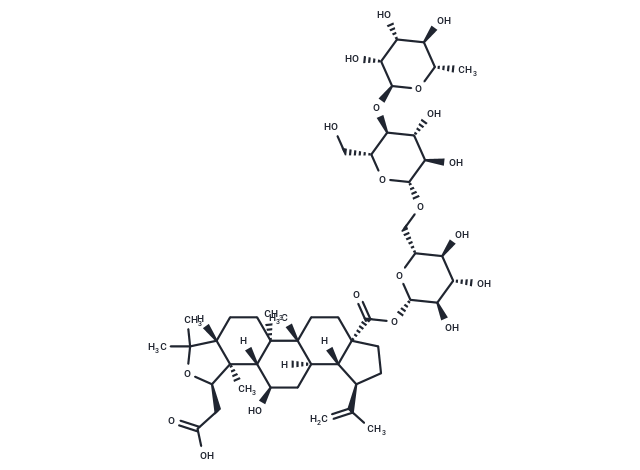
Isochiisanoside
CAS No. 105591-35-3
Isochiisanoside( —— )
Catalog No. M37829 CAS No. 105591-35-3
Isochiisanoside is a natural product found in the leaves of Acanthopanax chiisanensis NAKAI.
Purity : >98% (HPLC)
 COA
Datasheet
HNMR
HPLC
MSDS
Handing Instructions
COA
Datasheet
HNMR
HPLC
MSDS
Handing Instructions
| Size | Price / USD | Stock | Quantity |
| 2MG | 278 | In Stock |


|
| 5MG | 425 | In Stock |
|
| 10MG | 626 | In Stock |
|
| 25MG | 938 | In Stock |
|
| 50MG | 1283 | In Stock |
|
| 100MG | Get Quote | In Stock |
|
| 200MG | Get Quote | In Stock |
|
| 500MG | Get Quote | In Stock |
|
| 1G | Get Quote | In Stock |
|
Biological Information
-
Product NameIsochiisanoside
-
NoteResearch use only, not for human use.
-
Brief DescriptionIsochiisanoside is a natural product found in the leaves of Acanthopanax chiisanensis NAKAI.
-
DescriptionIsochiisanoside is a natural product found in the leaves of Acanthopanax chiisanensis NAKAI.
-
In Vitro——
-
In Vivo——
-
Synonyms——
-
PathwayOthers
-
TargetOther Targets
-
RecptorOthers
-
Research Area——
-
Indication——
Chemical Information
-
CAS Number105591-35-3
-
Formula Weight973.1
-
Molecular FormulaC48H76O20
-
Purity>98% (HPLC)
-
Solubility——
-
SMILESC(O[C@@H]1O[C@H](CO[C@@H]2O[C@H](CO)[C@@H](O[C@H]3[C@H](O)[C@H](O)[C@@H](O)[C@H](C)O3)[C@H](O)[C@H]2O)[C@@H](O)[C@H](O)[C@H]1O)(=O)[C@]45[C@@]([C@@]6([C@@](C)(CC4)[C@@]7(C)[C@]([C@H](O)C6)([C@]8(C)[C@@](CC7)(C(C)(C)O[C@@H]8CC(O)=O)[H])[H])[H])([C@H](C(C)=C)CC5)[H]
-
Chemical Name——
Shipping & Storage Information
-
Storage(-20℃)
-
ShippingWith Ice Pack
-
Stability≥ 2 years
Reference
molnova catalog



related products
-
Kynurenine
Kynurenine is synthesized by the enzyme tryptophan dioxygenase, which is made primarily but not exclusively in the liver.
-
Rhizoferrin
Rhizoferrin is a novel iron carrier from the fungus Rhizopus microsporus var. rhizopodiformis for the study of iron-deficiency-induced chlorosis in plants.
-
Maleimide
Maleimide (25-Pyrroledone) is a new nanoparticle surface functional group which favors easy conjugation with cell penetration peptides. The conjugation is enabled via click chemistry to preserve its biofunctions.
