


 Cart
 sales@molnova.com


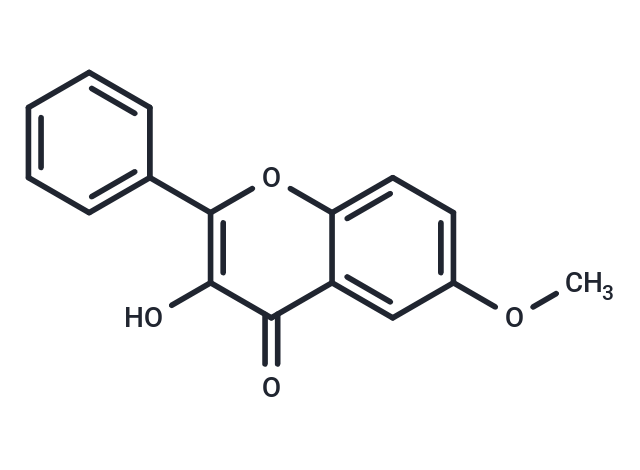
3-Hydroxy-6-methoxyflavone
CAS No. 93176-00-2
3-Hydroxy-6-methoxyflavone( —— )
Catalog No. M37753 CAS No. 93176-00-2
3-Hydroxy-6-methoxyflavone can be used in combination with antibiotics to treat ESKAPE pathogen infections.
Purity : >98% (HPLC)
 COA
Datasheet
HNMR
HPLC
MSDS
Handing Instructions
| Size | Price / USD | Stock | Quantity |
| 1 mL x 10 mM in DMSO | 29 | In Stock |


|
| 25MG | 30 | In Stock |
|
| 50MG | 43 | In Stock |
|
| 100MG | 61 | In Stock |
|
| 200MG | 89 | In Stock |
|
| 500MG | Get Quote | In Stock |
|
| 1G | Get Quote | In Stock |
|
Biological Information
-
Product Name3-Hydroxy-6-methoxyflavone
-
NoteResearch use only, not for human use.
-
Brief Description3-Hydroxy-6-methoxyflavone can be used in combination with antibiotics to treat ESKAPE pathogen infections.
-
Description6-Methoxyflavonol (Compound 15) is a natural flavone isolated from the marine-derived fungus Aspergillus candidus.
-
In Vitro——
-
In Vivo——
-
Synonyms——
-
PathwayOthers
-
TargetOther Targets
-
RecptorOthers
-
Research Area——
-
Indication——
Chemical Information
-
CAS Number93176-00-2
-
Formula Weight268.26
-
Molecular FormulaC16H12O4
-
Purity>98% (HPLC)
-
Solubility——
-
SMILESO=C1C=2C(OC(=C1O)C3=CC=CC=C3)=CC=C(OC)C2
-
Chemical Name——
Shipping & Storage Information
-
Storage(-20℃)
-
ShippingWith Ice Pack
-
Stability≥ 2 years
Reference
1. Haider W, et al. Natural Flavones and their Preliminary Structure–Antifouling Activity Relationship [J]. Chemistry of Natural Compounds, 2020, 56: 334-337.
molnova catalog



related products
-
C12-200
C12-200 is a benchmark ionizable cationic lipidoid along with helper lipids. C12-200 is commonly used for mRNA delivery.
-
Levitide
Levitide is a neurohormone-like peptide, can be isolated from skin secretions of the South African frog Xenopus laevis. Levitide comes from preprolevitide, is 88 residues long and contains contains the levitide peptide at the C terminus (Glu-Gly-Met-Ile-Gly-Thr-Leu-Thr-Ser-Lys-Arg-Ile-Lys-Gln-NH2) and the putative signal sequence at the N terminus.
-
Bifendatatum
Bifendatatum is commonly used to treat the transaminase elevation that caused by viral hepatitis and drug induced liver injury.
