


 Cart
Cart
 sales@molnova.com


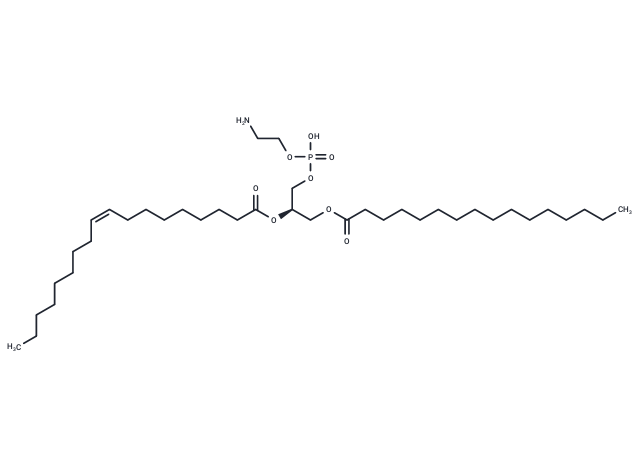
POPE
CAS No. 26662-94-2
POPE( —— )
Catalog No. M37715 CAS No. 26662-94-2
POPE is a compound found in Escherichia coli, part of the cell membrane, and can be used to study changes in cell membrane permeability.
Purity : >98% (HPLC)
 COA
Datasheet
HNMR
HPLC
MSDS
Handing Instructions
COA
Datasheet
HNMR
HPLC
MSDS
Handing Instructions
| Size | Price / USD | Stock | Quantity |
| 10MG | 35 | In Stock |


|
| 25MG | 59 | In Stock |
|
| 50MG | 86 | In Stock |
|
| 100MG | Get Quote | In Stock |
|
| 200MG | Get Quote | In Stock |
|
| 500MG | Get Quote | In Stock |
|
| 1G | Get Quote | In Stock |
|
Biological Information
-
Product NamePOPE
-
NoteResearch use only, not for human use.
-
Brief DescriptionPOPE is a compound found in Escherichia coli, part of the cell membrane, and can be used to study changes in cell membrane permeability.
-
Description1-Palmitoyl-2-oleoyl-sn-glycero-3-PE is a phospholipid, and can be used for drug delivery.
-
In Vitro——
-
In Vivo——
-
Synonyms——
-
PathwayOthers
-
TargetOther Targets
-
RecptorOthers
-
Research Area——
-
Indication——
Chemical Information
-
CAS Number26662-94-2
-
Formula Weight718
-
Molecular FormulaC39H76NO8P
-
Purity>98% (HPLC)
-
SolubilityIn Vitro:?Methanol : 2.5 mg/mL (3.48 mM; Ultrasonic (<60°C)
-
SMILES[C@@H](OC(CCCCCCC/C=C\CCCCCCCC)=O)(COC(CCCCCCCCCCCCCCC)=O)COP(OCCN)(=O)O
-
Chemical Name——
Shipping & Storage Information
-
Storage(-20℃)
-
ShippingWith Ice Pack
-
Stability≥ 2 years
Reference
1. álvarez-Benedicto E, et al. Optimization of phospholipid chemistry for improved lipid nanoparticle (LNP) delivery of messenger RNA (mRNA). Biomater Sci. 2022 Jan 18;10(2):549-559.?
molnova catalog



related products
-
Ivangustin
Ivangustin exhibits remarkable cytotoxicity against HEp2, SGC-7901 and HCT116 human cancer cell lines.
-
DLinDAP
DLinDAP (D-LinDAP) is an ionizable cationic lipid used for SiRNA delivery.
-
Angiotensin II Recep...
Angiotensin II Receptor, AT2, Amino Terminal Fragment
