


 Cart
Cart
 sales@molnova.com


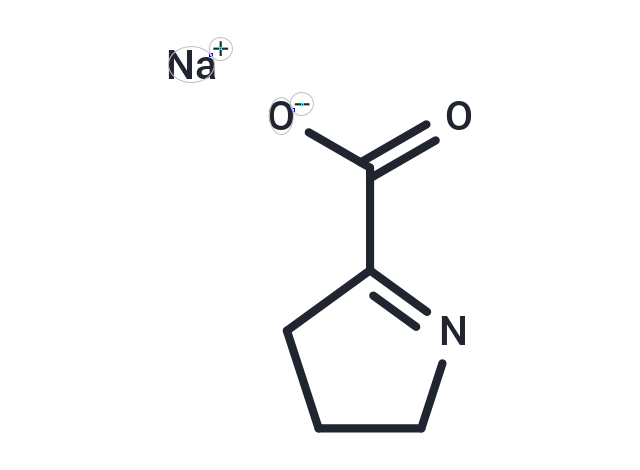
Pyrroline-5-carboxylate sodium
CAS No. 72978-16-6
Pyrroline-5-carboxylate sodium( —— )
Catalog No. M37600 CAS No. 72978-16-6
Pyrroline-5-carboxylate sodium is a naturally occurring intermediate and a potent activator of redox-dependent metabolic pathways and a PROTAC linker.
Purity : >98% (HPLC)
 COA
Datasheet
HNMR
HPLC
MSDS
Handing Instructions
COA
Datasheet
HNMR
HPLC
MSDS
Handing Instructions
| Size | Price / USD | Stock | Quantity |
| 2MG | 117 | Get Quote |


|
| 100MG | Get Quote | Get Quote |
|
| 200MG | Get Quote | Get Quote |
|
| 500MG | Get Quote | Get Quote |
|
| 1G | Get Quote | Get Quote |
|
Biological Information
-
Product NamePyrroline-5-carboxylate sodium
-
NoteResearch use only, not for human use.
-
Brief DescriptionPyrroline-5-carboxylate sodium is a naturally occurring intermediate and a potent activator of redox-dependent metabolic pathways and a PROTAC linker.
-
DescriptionPyrroline-5-carboxylate sodium is a naturally occurring intermediate and a potent activator of redox-dependent metabolic pathways and a PROTAC linker.
-
In Vitro——
-
In Vivo——
-
Synonyms——
-
PathwayPROTACs
-
TargetPROTAC
-
RecptorPROTAC Linker
-
Research Area——
-
Indication——
Chemical Information
-
CAS Number72978-16-6
-
Formula Weight135.1
-
Molecular FormulaC5H6NNaO2
-
Purity>98% (HPLC)
-
Solubility——
-
SMILESO=C(C1=NCCC1)[O-].[Na+]
-
Chemical Name——
Shipping & Storage Information
-
Storage(-20℃)
-
ShippingWith Ice Pack
-
Stability≥ 2 years
Reference
molnova catalog



related products
-
Hydroxy-PEG6-Boc
Hydroxy-PEG7-Boc is a PEG-based PROTAC linker that can be used in the synthesis of PROTACs.
-
QCA570
QCA570 is a novel, highly potent efficacious BET degrader (PROTAC); effectively induces degradation of BET proteins and inhibits cell growth in human acute leukemia cell lines at pM level.
-
m-PEG11-Br
m-PEG11-Br is a PEG-based PROTAC linker that can be used in the synthesis of PROTACs.
