


 Cart
 sales@molnova.com


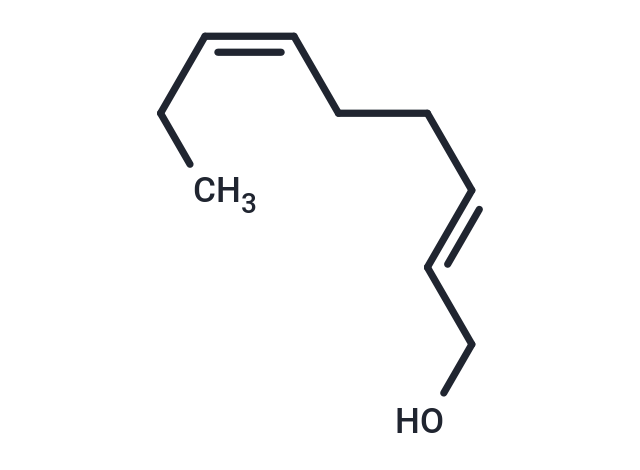
(Z)-3-Hexenyl isovalerate
CAS No. 35154-45-1
(Z)-3-Hexenyl isovalerate( —— )
Catalog No. M37421 CAS No. 35154-45-1
(Z)-3-Hexenyl isovalerate ((3Z)-3-Hexen-1-yl 3-methylbutanoate) is a RIFM fragrance and one of the aroma components in Xinyang Maojian.
Purity : >98% (HPLC)
 COA
Datasheet
HNMR
HPLC
MSDS
Handing Instructions
| Size | Price / USD | Stock | Quantity |
| 10MG | 30 | In Stock |


|
| 25MG | 46 | In Stock |
|
| 50MG | 62 | In Stock |
|
| 100MG | 88 | In Stock |
|
| 200MG | 128 | In Stock |
|
| 500MG | 213 | In Stock |
|
| 1G | 315 | In Stock |
|
Biological Information
-
Product Name(Z)-3-Hexenyl isovalerate
-
NoteResearch use only, not for human use.
-
Brief Description(Z)-3-Hexenyl isovalerate ((3Z)-3-Hexen-1-yl 3-methylbutanoate) is a RIFM fragrance and one of the aroma components in Xinyang Maojian.
-
Description(Z)-3-Hexenyl isovalerate ((3Z)-3-Hexen-1-yl 3-methylbutanoate) is a RIFM fragrance and one of the aroma components in Xinyang Maojian.
-
In Vitro——
-
In Vivo——
-
Synonyms——
-
PathwayOthers
-
TargetOther Targets
-
RecptorOthers
-
Research Area——
-
Indication——
Chemical Information
-
CAS Number35154-45-1
-
Formula Weight184.28
-
Molecular FormulaC11H20O2
-
Purity>98% (HPLC)
-
Solubility——
-
SMILESC(C/C=C/CO)/C=C\CC
-
Chemical Name——
Shipping & Storage Information
-
Storage(-20℃)
-
ShippingWith Ice Pack
-
Stability≥ 2 years
Reference
molnova catalog



related products
-
Hexadecanedioic acid
Hexadecanedioic acid is a common saturated fatty acid found in animals plants and microorganisms. It has antitumor activity.
-
1,7-Diphenyl-5-hydro...
1,7-Diphenyl-5-hydroxy-4,6-hepten-3-one is a natural product of Alpinia, Zingiberaceae. 1,7-Diphenyl-5-hydroxy-4,6-hepten-3-one can be used as a reference standard.
-
Suc-Leu-Tyr-AMC
Suc-Leu-Tyr-AMC is a fluorescent substrate for calpain I and II, papain (another cysteine protease), and is used to measure the chymotrypsin-like peptidase activity of the 20S proteasome (excitation max: 360 nm; emission max: 460 nm). Suc-Leu-Tyr-AMC can also be cleaved by the Ti protease from E. coli.
