


 Cart
Cart
 sales@molnova.com


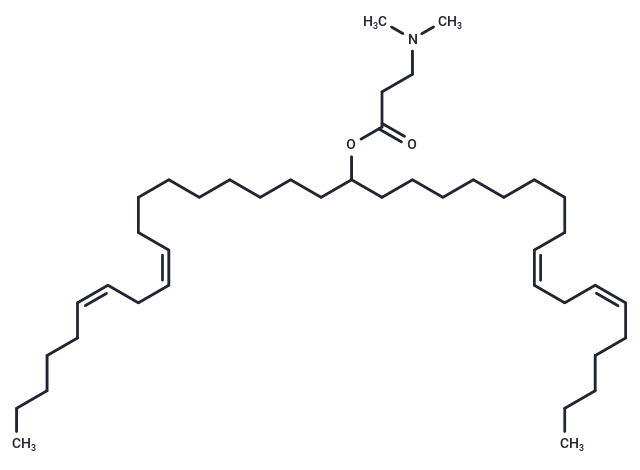
DLIN-MC2-DMA
CAS No. 1221271-55-1
DLIN-MC2-DMA( —— )
Catalog No. M37349 CAS No. 1221271-55-1
DLIN-MC2-DMA (DLin-M-C2-DMA) is a lipid membrane and a potential nucleic acid carrier.
Purity : >98% (HPLC)
 COA
Datasheet
HNMR
HPLC
MSDS
Handing Instructions
COA
Datasheet
HNMR
HPLC
MSDS
Handing Instructions
| Size | Price / USD | Stock | Quantity |
| 5MG | 35 | In Stock |


|
| 10MG | 56 | In Stock |
|
| 25MG | 119 | In Stock |
|
| 50MG | 192 | In Stock |
|
| 100MG | 310 | In Stock |
|
| 200MG | 462 | In Stock |
|
| 500MG | Get Quote | In Stock |
|
| 1G | Get Quote | In Stock |
|
Biological Information
-
Product NameDLIN-MC2-DMA
-
NoteResearch use only, not for human use.
-
Brief DescriptionDLIN-MC2-DMA (DLin-M-C2-DMA) is a lipid membrane and a potential nucleic acid carrier.
-
DescriptionDLin-M-K-DMA (DLin-M-C2-DMA) is a cationic lipid that can be used in the construction of biological delivery vectors.
-
In Vitro——
-
In Vivo——
-
Synonyms——
-
PathwayOthers
-
TargetOther Targets
-
RecptorOthers
-
Research Area——
-
Indication——
Chemical Information
-
CAS Number1221271-55-1
-
Formula Weight628.07
-
Molecular FormulaC42H77NO2
-
Purity>98% (HPLC)
-
SolubilityIn Vitro:?DMSO : 100 mg/mL (159.22 mM; Ultrasonic )
-
SMILESC(OC(CCN(C)C)=O)(CCCCCCCC/C=C\C/C=C\CCCCC)CCCCCCCC/C=C\C/C=C\CCCCC
-
Chemical Name——
Shipping & Storage Information
-
Storage(-20℃)
-
ShippingWith Ice Pack
-
Stability≥ 2 years
Reference
1. Michael J, et al. Improved amino lipids and methods for the delivery of nucleic acids. WO2010042877A1.
molnova catalog



related products
-
β-Endorphin, rat
β-Endorphin, rat
-
(E)-Coniferin
(E)-Coniferin is the isomer of Coniferin. Coniferin is a glucoside of coniferyl alcohol. Coniferin inhibits?fungal?growth and melanization.
-
Iobenguane sulfate
Iobenguane sulfate is a high-affinity substrate for cholera toxin that interferes with cellular mono(ADP-ribosylation). Radioiodinated Iobenguane sulfate is clinically used as a tumor-targeted radiopharmaceutical in the diagnosis and treatment of adrenergic tumors.
