


 Cart
Cart
 sales@molnova.com


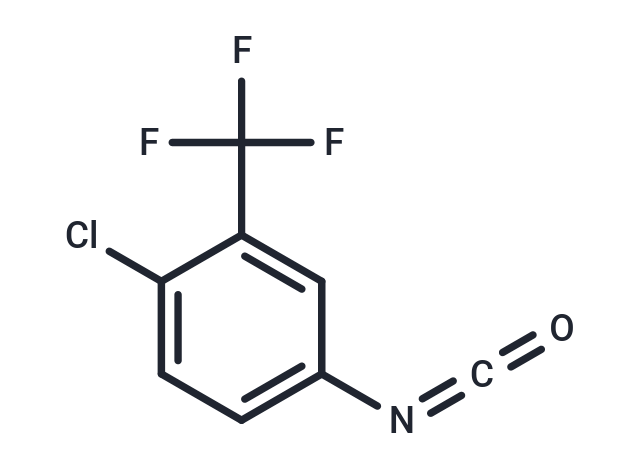
4-Chloro-3-(trifluoromethyl)phenyl isocyanate
CAS No. 327-78-6
4-Chloro-3-(trifluoromethyl)phenyl isocyanate( —— )
Catalog No. M37066 CAS No. 327-78-6
4-Chloro-3-(trifluoromethyl)phenyl isocyanate is a biochemical reagent that can be produced by a series of reactions between o-chlorobenzotrifluoride and acetic anhydride.
Purity : >98% (HPLC)
 COA
Datasheet
HNMR
HPLC
MSDS
Handing Instructions
COA
Datasheet
HNMR
HPLC
MSDS
Handing Instructions
| Size | Price / USD | Stock | Quantity |
| 100MG | Get Quote | In Stock |


|
| 200MG | Get Quote | In Stock |
|
| 500MG | 27 | In Stock |
|
| 1G | Get Quote | In Stock |
|
Biological Information
-
Product Name4-Chloro-3-(trifluoromethyl)phenyl isocyanate
-
NoteResearch use only, not for human use.
-
Brief Description4-Chloro-3-(trifluoromethyl)phenyl isocyanate is a biochemical reagent that can be produced by a series of reactions between o-chlorobenzotrifluoride and acetic anhydride.
-
Description4-Chloro-3-(trifluoromethyl)phenyl isocyanate is a biochemical reagent that can be produced by a series of reactions between o-chlorobenzotrifluoride and acetic anhydride.
-
In Vitro——
-
In Vivo——
-
Synonyms——
-
PathwayOthers
-
TargetOther Targets
-
RecptorOthers
-
Research Area——
-
Indication——
Chemical Information
-
CAS Number327-78-6
-
Formula Weight221.56
-
Molecular FormulaC8H3ClF3NO
-
Purity>98% (HPLC)
-
Solubility——
-
SMILESFC(F)(F)c1cc(ccc1Cl)N=C=O
-
Chemical Name——
Shipping & Storage Information
-
Storage(-20℃)
-
ShippingWith Ice Pack
-
Stability≥ 2 years
Reference
molnova catalog



related products
-
24-Methylenecholeste...
24-Methylenecholesterol is a natural marine sterol, which stimulates cholesterol acyl transferase (ACAT) in human macrophages.
-
SMI481
SMI481 is the first small-molecule Sec14-like phosphatidylinositol transfer proteins (PITPs) inhibitor.
-
Ipriflavone
Ipriflavone (7-Isopropoxyisoflavon) is used to inhibit bone resorption.
