


 Cart
Cart
 sales@molnova.com


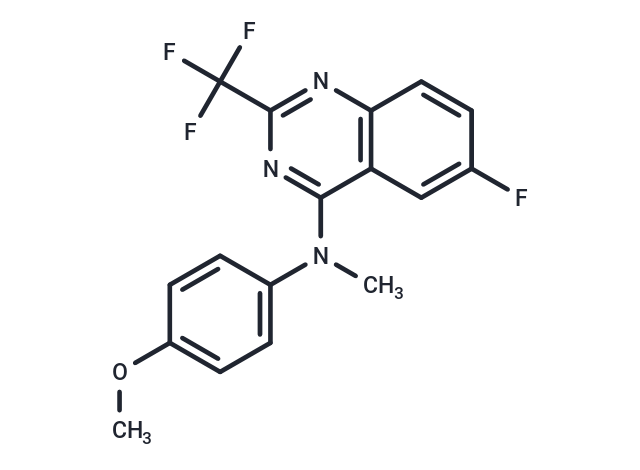
Tubulin polymerization-IN-43
CAS No. 2773345-90-5
Tubulin polymerization-IN-43( —— )
Catalog No. M37016 CAS No. 2773345-90-5
Tubulin polymerization-IN-43 is an inhibitor of tubulin polymerisation.
Purity : >98% (HPLC)
 COA
Datasheet
HNMR
HPLC
MSDS
Handing Instructions
COA
Datasheet
HNMR
HPLC
MSDS
Handing Instructions
| Size | Price / USD | Stock | Quantity |
| 5MG | 139 | In Stock |


|
| 10MG | 197 | In Stock |
|
| 25MG | 326 | In Stock |
|
| 50MG | 421 | In Stock |
|
| 100MG | 578 | In Stock |
|
| 200MG | 775 | In Stock |
|
| 500MG | Get Quote | In Stock |
|
| 1G | Get Quote | In Stock |
|
Biological Information
-
Product NameTubulin polymerization-IN-43
-
NoteResearch use only, not for human use.
-
Brief DescriptionTubulin polymerization-IN-43 is an inhibitor of tubulin polymerisation.
-
DescriptionTubulin polymerization-IN-43 (compound 15h) is a tubulin polymerization inhibitor. Tubulin polymerization-IN-43 disrupts cellular microtubule networks by targeting the Colchicine (HY-16569) site, and promots cell cycle arrest of leukemia cells at G2/M phase and cell apoptosis, as well as inhibiting angiogenesis.
-
In Vitro——
-
In Vivo——
-
Synonyms——
-
PathwayApoptosis
-
TargetApoptosis
-
RecptorApoptosis | Microtubule Associated
-
Research Area——
-
Indication——
Chemical Information
-
CAS Number2773345-90-5
-
Formula Weight351.3
-
Molecular FormulaC17H13F4N3O
-
Purity>98% (HPLC)
-
Solubility——
-
SMILESN(C)(C=1C2=C(N=C(C(F)(F)F)N1)C=CC(F)=C2)C3=CC=C(OC)C=C3
-
Chemical Name——
Shipping & Storage Information
-
Storage(-20℃)
-
ShippingWith Ice Pack
-
Stability≥ 2 years
Reference
1. Wu H, et, al. Discovery of novel N-aryl-2-trifluoromethyl-quinazoline-4-amine derivatives as the inhibitors of tubulin polymerization in leukemia cells. Eur J Med Chem. 2023 Aug 5;256:115470.?
molnova catalog



related products
-
Geranylgeraniol
Geranylgeraniol is an isoprenoid found in fruits, vegetables, and grains, including rice. Geranylgeraniol inhibits growth and induces apoptosis of various tumor cells. Geranylgeraniol protects monocytes against statin-induced cytotoxicity and suppresses the growth of Mycobacterium.
-
Thrombospondin-1 (10...
Thrombospondin-1 (1016-1023) [human, bovine, mouse], a segment of Thrombospondin-1 (TSP-1), functions as a CD47 agonist.
-
Adarotene
Adarotene is an effective apoptosis inducer. It surprisingly produces DNA damage and exhibits a potent antiproliferative activity on a large panel of human tumor cells.
