


 Cart
Cart
 sales@molnova.com


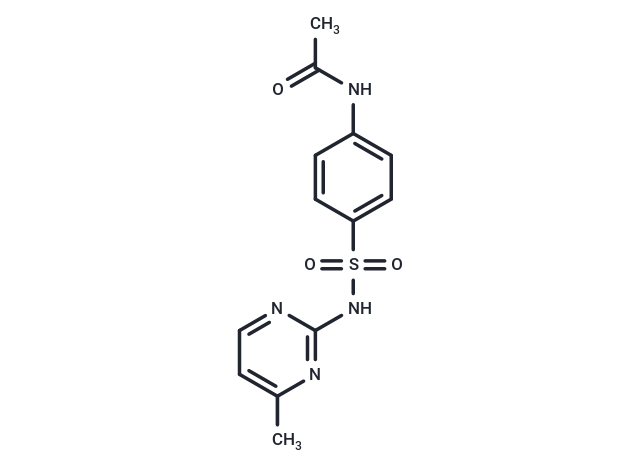
Acetylsulfamerazine
CAS No. 127-73-1
Acetylsulfamerazine( —— )
Catalog No. M36409 CAS No. 127-73-1
Acetylsulfamerazine (N-Acetylsulfamerazine) is a secondary metabolite of sulphamethazine, which has a slight inhibitory effect on cellulose digestion and rumen endocrine activity, and has anti-microbial activity.
Purity : >98% (HPLC)
 COA
Datasheet
HNMR
HPLC
MSDS
Handing Instructions
COA
Datasheet
HNMR
HPLC
MSDS
Handing Instructions
| Size | Price / USD | Stock | Quantity |
| 5MG | 48 | In Stock |


|
| 10MG | 56 | In Stock |
|
| 25MG | 89 | In Stock |
|
| 50MG | 127 | In Stock |
|
| 100MG | 171 | In Stock |
|
| 200MG | Get Quote | In Stock |
|
| 500MG | Get Quote | In Stock |
|
| 1G | Get Quote | In Stock |
|
Biological Information
-
Product NameAcetylsulfamerazine
-
NoteResearch use only, not for human use.
-
Brief DescriptionAcetylsulfamerazine (N-Acetylsulfamerazine) is a secondary metabolite of sulphamethazine, which has a slight inhibitory effect on cellulose digestion and rumen endocrine activity, and has anti-microbial activity.
-
DescriptionAcetylsulfamerazine (N-Acetylsulfamerazine) is a secondary metabolite of sulphamethazine, which has a slight inhibitory effect on cellulose digestion and rumen endocrine activity, and has anti-microbial activity.
-
In Vitro——
-
In Vivo——
-
Synonyms——
-
PathwayOthers
-
TargetOther Targets
-
RecptorDrug Metabolite
-
Research Area——
-
Indication——
Chemical Information
-
CAS Number127-73-1
-
Formula Weight306.34
-
Molecular FormulaC13H14N4O3S
-
Purity>98% (HPLC)
-
Solubility——
-
SMILESCC(=O)NC1=CC=C(C=C1)S(=O)(=O)NC1=NC(C)=CC=N1
-
Chemical Name——
Shipping & Storage Information
-
Storage(-20℃)
-
ShippingWith Ice Pack
-
Stability≥ 2 years
Reference
molnova catalog



related products
-
4-P-PDOT
4-P-PDOT is a potent, selective and affinity Melatonin receptor (MT2) antagonist.
-
Cyanidin3-(6-(2-(p)-...
Cyanidin3-(6-(2-(p)-coumarate-β-D-glucopyranosyl)-β-D-glucopyranosyl)-5-glucopyranoside
-
1-IODOADAMANTANE
1-Iodoadamantane is employed in the free-radical carbonylation reactions with alkenes.
