


 Cart
Cart
 sales@molnova.com


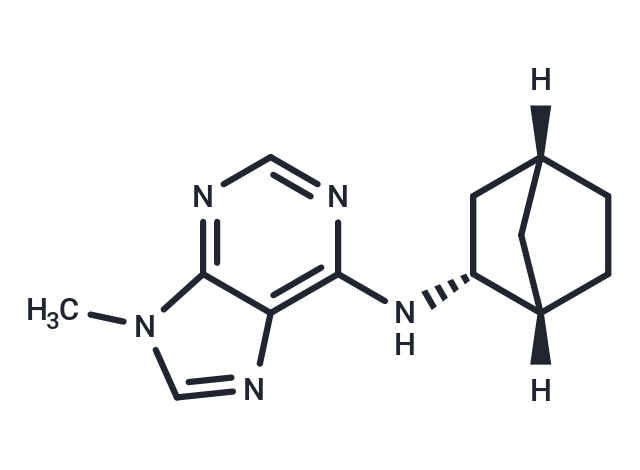
N 0861
CAS No. 141696-90-4
N 0861( —— )
Catalog No. M36353 CAS No. 141696-90-4
N 0861 is a selective adenosine A1 receptor antagonist that attenuates renal insufficiency during adenosine-controlled hypotension in rats.
Purity : >98% (HPLC)
 COA
Datasheet
HNMR
HPLC
MSDS
Handing Instructions
COA
Datasheet
HNMR
HPLC
MSDS
Handing Instructions
| Size | Price / USD | Stock | Quantity |
| 2MG | 246 | In Stock |


|
| 5MG | 411 | In Stock |
|
| 10MG | 562 | In Stock |
|
| 25MG | 866 | In Stock |
|
| 50MG | 1097 | In Stock |
|
| 100MG | 1469 | In Stock |
|
| 200MG | 2009 | In Stock |
|
| 500MG | Get Quote | In Stock |
|
| 1G | Get Quote | In Stock |
|
Biological Information
-
Product NameN 0861
-
NoteResearch use only, not for human use.
-
Brief DescriptionN 0861 is a selective adenosine A1 receptor antagonist that attenuates renal insufficiency during adenosine-controlled hypotension in rats.
-
DescriptionN 0861 is a selective adenosine A1 receptor antagonist that attenuates renal insufficiency during adenosine-controlled hypotension in rats.
-
In Vitro——
-
In Vivo——
-
Synonyms——
-
PathwayGPCR/G Protein
-
TargetAdenosine Receptor
-
RecptorAdenosine Receptor
-
Research Area——
-
Indication——
Chemical Information
-
CAS Number141696-90-4
-
Formula Weight243.31
-
Molecular FormulaC13H17N5
-
Purity>98% (HPLC)
-
Solubility——
-
SMILESN(C1=C2C(N(C)C=N2)=NC=N1)[C@H]3[C@@]4(C[C@](C3)(CC4)[H])[H]
-
Chemical Name——
Shipping & Storage Information
-
Storage(-20℃)
-
ShippingWith Ice Pack
-
Stability≥ 2 years
Reference
molnova catalog



related products
-
CGS 21680
CGS 21680 is a specific adenosine A2A subtype receptor agonist with Ki of 27 nM.
-
N6-Cyclopentyladenos...
N6-Cyclopentyladenosine (CPA) is a selective agonist of the adenosine A1 receptor, mimicking its action with Ki values of 2.3 nM, 790 nM, and 43 nM for human A1, A2A, and A3 receptors, respectively.
-
2-Cl-IB-MECA
2-Cl-IB-MECA (Chloro-IB-MECA, CF-102, Namodenoson) is a potent, selective A3 adenosine receptor agonist with Ki of 0.33 nM, 2500- and 1400-fold selectivity over A1 and A2a receptors.
