


 Cart
Cart
 sales@molnova.com


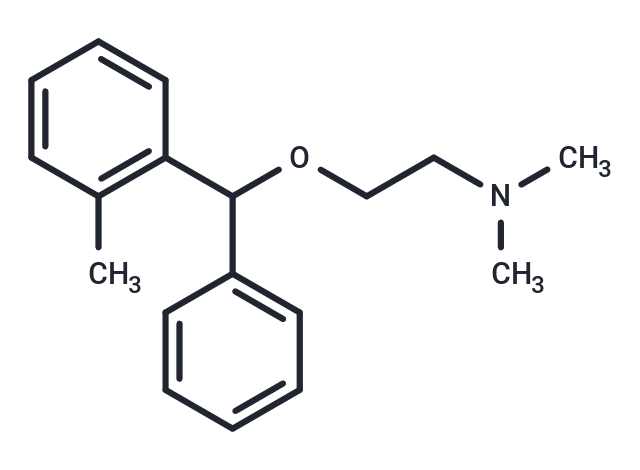
Orphenadrine
CAS No. 83-98-7
Orphenadrine( —— )
Catalog No. M36262 CAS No. 83-98-7
Orphenadrine is a noncompetitive N-methyl-D-aspartate (NMDA) receptor antagonist that inhibits clonal HERG channels in a concentration-dependent manner, producing an IC of 0.85 μM in HEK cells.
Purity : >98% (HPLC)
 COA
Datasheet
HNMR
HPLC
MSDS
Handing Instructions
COA
Datasheet
HNMR
HPLC
MSDS
Handing Instructions
| Size | Price / USD | Stock | Quantity |
| 5MG | 49 | In Stock |


|
| 10MG | 65 | In Stock |
|
| 25MG | 105 | In Stock |
|
| 50MG | 147 | In Stock |
|
| 100MG | 219 | In Stock |
|
| 200MG | Get Quote | In Stock |
|
| 500MG | Get Quote | In Stock |
|
| 1G | Get Quote | In Stock |
|
Biological Information
-
Product NameOrphenadrine
-
NoteResearch use only, not for human use.
-
Brief DescriptionOrphenadrine is a noncompetitive N-methyl-D-aspartate (NMDA) receptor antagonist that inhibits clonal HERG channels in a concentration-dependent manner, producing an IC of 0.85 μM in HEK cells.
-
DescriptionOrphenadrine is a noncompetitive N-methyl-D-aspartate (NMDA) receptor antagonist that inhibits clonal HERG channels in a concentration-dependent manner, producing an IC of 0.85 μM in HEK cells.Orphenadrine is an antagonist of central and peripheral muscarinic receptors. Attenuation is blocked by mutations in pore residues Y652 or F656. Orphenadrine has antispasmodic, analgesic, and anticholinergic activity and protects against glutamatergic neurotoxicity in vitro and in vivo.Orphenadrine has inhibitory effects on sodium channels and can be used in the treatment of Parkinson's disease.
-
In Vitro——
-
In Vivo——
-
Synonyms——
-
PathwayMembrane Transporter/Ion Channel
-
TargetNMDAR
-
RecptorNMDAR | Sodium Channel | AChR
-
Research Area——
-
Indication——
Chemical Information
-
CAS Number83-98-7
-
Formula Weight269.38
-
Molecular FormulaC18H23NO
-
Purity>98% (HPLC)
-
Solubility——
-
SMILESC(OCCN(C)C)(C1=C(C)C=CC=C1)C2=CC=CC=C2
-
Chemical Name——
Shipping & Storage Information
-
Storage(-20℃)
-
ShippingWith Ice Pack
-
Stability≥ 2 years
Reference
molnova catalog



related products
-
N-Methyl-DL-aspartic...
N-Methyl-DL-aspartic acid, a glutamate analogue and NMDA receptor agonist, is utilized in neurological disease research.
-
Delucemine Hydrochlo...
Delucemine Hydrochloride (Delucemine) is a polyamine NMDA receptor antagonist used in the study of neurological disorders such as depression and Alzheimer's disease.
-
Spermidine hydrochlo...
Spermidine a natural polyamine is a novel autophagy inducer and negatively modulates N-methyl-d-aspartate (NMDA).
