


 Cart
Cart
 sales@molnova.com


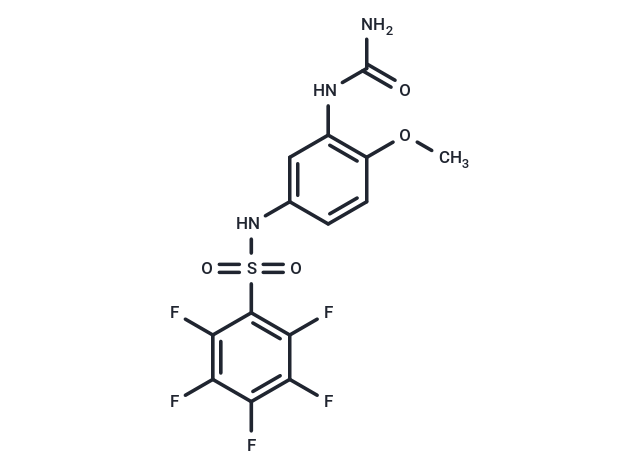
T-900607
CAS No. 261944-52-9
T-900607( —— )
Catalog No. M36231 CAS No. 261944-52-9
T-900607 is a novel microtubule protein active agent that disrupts microtubule polymerization through a unique mechanism of action. t-900607 is cardiotoxic.
Purity : >98% (HPLC)
 COA
Datasheet
HNMR
HPLC
MSDS
Handing Instructions
COA
Datasheet
HNMR
HPLC
MSDS
Handing Instructions
| Size | Price / USD | Stock | Quantity |
| 1 mL x 10 mM in DMSO | 191 | In Stock |


|
| 5MG | 172 | In Stock |
|
| 10MG | 254 | In Stock |
|
| 25MG | 392 | In Stock |
|
| 50MG | 531 | In Stock |
|
| 100MG | 710 | In Stock |
|
| 200MG | 958 | In Stock |
|
| 500MG | Get Quote | In Stock |
|
| 1G | Get Quote | In Stock |
|
Biological Information
-
Product NameT-900607
-
NoteResearch use only, not for human use.
-
Brief DescriptionT-900607 is a novel microtubule protein active agent that disrupts microtubule polymerization through a unique mechanism of action. t-900607 is cardiotoxic.
-
DescriptionT-900607 is a novel microtubule protein active agent that disrupts microtubule polymerization through a unique mechanism of action. t-900607 is cardiotoxic.
-
In Vitro——
-
In Vivo——
-
Synonyms——
-
PathwayOthers
-
TargetOther Targets
-
RecptorMicrotubule Associated
-
Research Area——
-
Indication——
Chemical Information
-
CAS Number261944-52-9
-
Formula Weight411.3
-
Molecular FormulaC14H10F5N3O4S
-
Purity>98% (HPLC)
-
Solubility——
-
SMILESN(S(=O)(=O)C1=C(F)C(F)=C(F)C(F)=C1F)C2=CC(NC(N)=O)=C(OC)C=C2
-
Chemical Name——
Shipping & Storage Information
-
Storage(-20℃)
-
ShippingWith Ice Pack
-
Stability≥ 2 years
Reference
molnova catalog



related products
-
Eltrombopag Olamine
Eltrombopag Olamine is the orally active ethanolamine salt of eltrombopag, a small-molecule, nonpeptide thrombopoietin receptor agonist with megakaryopoiesis-stimulating activity.
-
PAR-2 (6-1) amide (h...
PAR-2 (6-1) amide (human)
-
[Asp5,6,Me-Phe8] Sub...
[Asp5,6,Me-Phe8] Substance P
