


 Cart
Cart
 sales@molnova.com


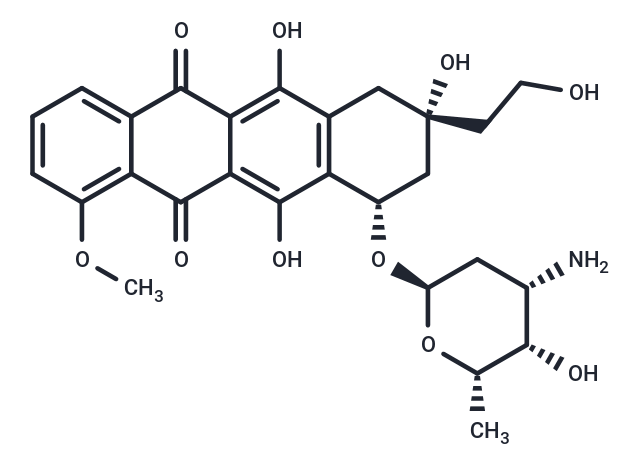
GPX-100
CAS No. 628290-43-7
GPX-100( —— )
Catalog No. M36121 CAS No. 628290-43-7
GPX-100 (13-deoxydoxorubicin) is an analogue of the anthracycline antitumour antibiotic doxorubicin.
Purity : >98% (HPLC)
 COA
Datasheet
HNMR
HPLC
MSDS
Handing Instructions
COA
Datasheet
HNMR
HPLC
MSDS
Handing Instructions
| Size | Price / USD | Stock | Quantity |
| 5MG | 223 | In Stock |


|
| 10MG | 330 | In Stock |
|
| 25MG | 557 | In Stock |
|
| 50MG | 779 | In Stock |
|
| 100MG | 1079 | In Stock |
|
| 200MG | Get Quote | In Stock |
|
| 500MG | Get Quote | In Stock |
|
| 1G | Get Quote | In Stock |
|
Biological Information
-
Product NameGPX-100
-
NoteResearch use only, not for human use.
-
Brief DescriptionGPX-100 (13-deoxydoxorubicin) is an analogue of the anthracycline antitumour antibiotic doxorubicin.
-
DescriptionGPX-100 (13-deoxydoxorubicin) is an analogue of the anthracycline antitumour antibiotic doxorubicin. GPX-100 inserts into DNA and interacts with topoisomerase II to inhibit DNA replication and repair as well as RNA and protein synthesis.
-
In Vitro——
-
In Vivo——
-
Synonyms——
-
PathwayOthers
-
TargetOther Targets
-
RecptorOthers
-
Research Area——
-
Indication——
Chemical Information
-
CAS Number628290-43-7
-
Formula Weight529.54
-
Molecular FormulaC27H31NO10
-
Purity>98% (HPLC)
-
Solubility——
-
SMILESOC=1C2=C([C@@H](O[C@H]3C[C@H](N)[C@H](O)[C@H](C)O3)C[C@@](CCO)(O)C2)C(O)=C4C1C(=O)C=5C(C4=O)=C(OC)C=CC5
-
Chemical Name——
Shipping & Storage Information
-
Storage(-20℃)
-
ShippingWith Ice Pack
-
Stability≥ 2 years
Reference
molnova catalog



related products
-
(Z)-Ganoderenic acid...
(Z)-Ganoderenic acid D
-
Verdiperstat
Verdiperstat (AZD-3241) is a potent, selective, reversible, orally active myeloperoxidase (MPO) inhibitor with IC50 of 630 nM, >14-fold selectivity over thyroid peroxidase (TPO).
-
Quassin
Quassin has female anti-fertility properties, possibly acting via inhibition of estrogen secretion.
