


 Cart
Cart
 sales@molnova.com


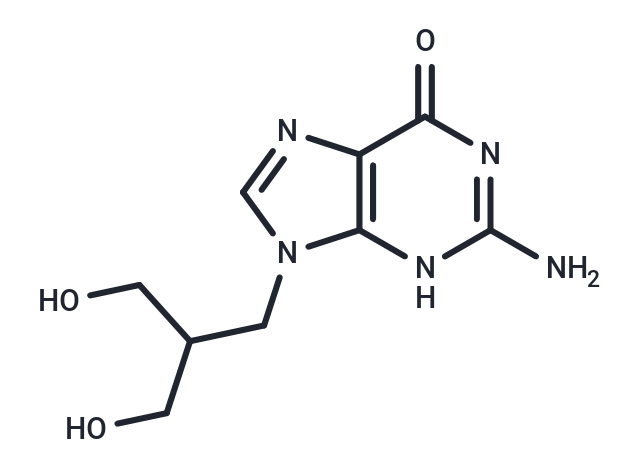
Tivicilovir
CAS No. 103024-93-7
Tivicilovir( —— )
Catalog No. M36003 CAS No. 103024-93-7
Tivicilovir (AM188) is a hepatitis B virus inhibitor. tiviclovir is a guanine-related acyclic 2'-deoxyguanine analogue with anti-herpesvirus activity.
Purity : >98% (HPLC)
 COA
Datasheet
HNMR
HPLC
MSDS
Handing Instructions
COA
Datasheet
HNMR
HPLC
MSDS
Handing Instructions
| Size | Price / USD | Stock | Quantity |
| 1 mL x 10 mM in DMSO | 283 | In Stock |


|
| 5MG | 323 | In Stock |
|
| 10MG | 485 | In Stock |
|
| 25MG | 787 | In Stock |
|
| 50MG | 1070 | In Stock |
|
| 100MG | 1442 | In Stock |
|
| 200MG | Get Quote | In Stock |
|
| 500MG | 2762 | In Stock |
|
| 1G | Get Quote | In Stock |
|
Biological Information
-
Product NameTivicilovir
-
NoteResearch use only, not for human use.
-
Brief DescriptionTivicilovir (AM188) is a hepatitis B virus inhibitor. tiviclovir is a guanine-related acyclic 2'-deoxyguanine analogue with anti-herpesvirus activity.
-
DescriptionTiviciclovir (AM188) is an antiviral guanosine analog and a hepatitis B virus inhibitor.
-
In Vitro——
-
In Vivo——
-
Synonyms——
-
PathwayMicrobiology/Virology
-
TargetAntifection
-
RecptorAntifection | HBV
-
Research Area——
-
Indication——
Chemical Information
-
CAS Number103024-93-7
-
Formula Weight239.23
-
Molecular FormulaC9H13N5O3
-
Purity>98% (HPLC)
-
Solubility——
-
SMILESC(C(CO)CO)N1C2=C(C(=O)N=C(N)N2)N=C1
-
Chemical Name——
Shipping & Storage Information
-
Storage(-20℃)
-
ShippingWith Ice Pack
-
Stability≥ 2 years
Reference
1. Wang J, et al. Renal excretion mechanisms of the antiviral nucleoside analogue AM 188 in the rat isolated perfused kidney. Clin Exp Pharmacol Physiol. 2004 Jan-Feb;31(1-2):29-34.?
molnova catalog



related products
-
GC376 sodium
GC376 is an inhibitor of 3C-like proteases (3CLpro) with IC50 values range from 0.49~4.35 μM.
-
Licoflavone B
Licoflavone B has schistosomicidal activity, it showed high S. mansoni ATPase (IC50 of 23.78 μM) and ADPase (IC50 of 31.50 μM) inhibitory activities.
-
Octahydrocurcumin
Octahydrocurcumin has antioxidant and and anti-inflammatory activities, it can inhibit the lipopolysaccharide (LPS)-induced inflammatory response via the mechanism of inhibiting NF-kB translocation to the nucleus.
