


 Cart
Cart
 sales@molnova.com


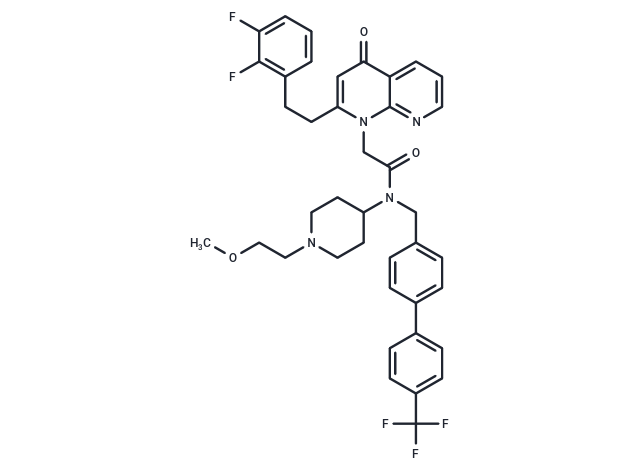
Goxalapladib
CAS No. 412950-27-7
Goxalapladib( —— )
Catalog No. M35993 CAS No. 412950-27-7
Goxalapladib(GSK 677116) is a small molecule compound that can be used to treat cardiovascular risks associated with atherosclerosis.
Purity : >98% (HPLC)
 COA
Datasheet
HNMR
HPLC
MSDS
Handing Instructions
COA
Datasheet
HNMR
HPLC
MSDS
Handing Instructions
| Size | Price / USD | Stock | Quantity |
| 5MG | 276 | In Stock |


|
| 10MG | 394 | In Stock |
|
| 25MG | 616 | In Stock |
|
| 50MG | 830 | In Stock |
|
| 100MG | 1097 | In Stock |
|
| 200MG | 1507 | In Stock |
|
| 500MG | Get Quote | In Stock |
|
| 1G | Get Quote | In Stock |
|
Biological Information
-
Product NameGoxalapladib
-
NoteResearch use only, not for human use.
-
Brief DescriptionGoxalapladib(GSK 677116) is a small molecule compound that can be used to treat cardiovascular risks associated with atherosclerosis.
-
DescriptionGoxalapladib(GSK 677116) is a small molecule compound that can be used to treat cardiovascular risks associated with atherosclerosis.
-
In Vitro——
-
In Vivo——
-
Synonyms——
-
PathwayOthers
-
TargetOther Targets
-
RecptorOthers
-
Research Area——
-
Indication——
Chemical Information
-
CAS Number412950-27-7
-
Formula Weight718.75
-
Molecular FormulaC40H39F5N4O3
-
Purity>98% (HPLC)
-
Solubility——
-
SMILESC(C(N(CC1=CC=C(C=C1)C2=CC=C(C(F)(F)F)C=C2)C3CCN(CCOC)CC3)=O)N4C=5C(C(=O)C=C4CCC6=C(F)C(F)=CC=C6)=CC=CN5
-
Chemical Name——
Shipping & Storage Information
-
Storage(-20℃)
-
ShippingWith Ice Pack
-
Stability≥ 2 years
Reference
molnova catalog



related products
-
Scutebarbatine A
Scutebarbatine A shows significant antitumor effects on A549 cells in vivo and in vitro via mitochondria-mediated apoptosis by up-regulating expressions of caspase-3 and 9, and down-regulating Bcl-2.
-
β III probe
β III probe
-
Astressin
Astressin is an amino-terminal truncated analog of CRF that retains high affinity binding to the extracellular domain of the receptor and is believed to act as a neutral competitive antagonist of receptor activation.
