


 Cart
Cart
 sales@molnova.com


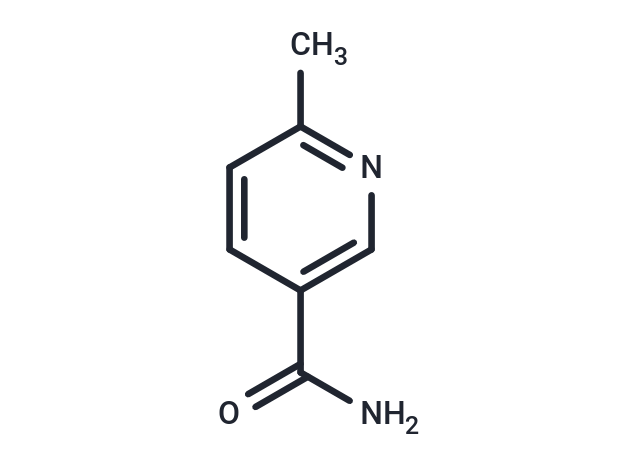
6-Methylnicotinamide
CAS No. 6960-22-1
6-Methylnicotinamide( —— )
Catalog No. M35895 CAS No. 6960-22-1
6-Methylnicotinamide is a derivative of nicotinamide, an endogenous metabolite. 6-Methylnicotinamide is used to make co-crystals/salts.
Purity : >98% (HPLC)
 COA
Datasheet
HNMR
HPLC
MSDS
Handing Instructions
COA
Datasheet
HNMR
HPLC
MSDS
Handing Instructions
| Size | Price / USD | Stock | Quantity |
| 1 mL x 10 mM in DMSO | 28 | In Stock |


|
| 100MG | Get Quote | In Stock |
|
| 200MG | Get Quote | In Stock |
|
| 500MG | Get Quote | In Stock |
|
| 1G | 27 | In Stock |
|
Biological Information
-
Product Name6-Methylnicotinamide
-
NoteResearch use only, not for human use.
-
Brief Description6-Methylnicotinamide is a derivative of nicotinamide, an endogenous metabolite. 6-Methylnicotinamide is used to make co-crystals/salts.
-
Description6-Methylnicotinamide, a derivate of nicotinamide, is an endogenous metabolite. A sudden increase of 6-methylnicotinamide in the acute stages of intracerebral hemorrhage (ICH) exacerbates neurological damages.
-
In Vitro——
-
In Vivo——
-
Synonyms——
-
PathwayProteasome/Ubiquitin
-
TargetEndogenous Metabolite
-
RecptorEndogenous Metabolite
-
Research Area——
-
Indication——
Chemical Information
-
CAS Number6960-22-1
-
Formula Weight136.15
-
Molecular FormulaC7H8N2O
-
Purity>98% (HPLC)
-
SolubilityIn Vitro:?DMSO : 50 mg/mL (367.24 mM; Ultrasonic )H2O : 3.33 mg/mL (24.46 mM; Ultrasonic (<60°C))
-
SMILESCC1=NC=C(C=C1)C(N)=O
-
Chemical Name——
Shipping & Storage Information
-
Storage(-20℃)
-
ShippingWith Ice Pack
-
Stability≥ 2 years
Reference
1. En Hu, et al. Temporal metabolomic alteration in rat brains of experimental intracerebral hemorrhage. Brain Res Bull. 2021 May;170:234-245.?
molnova catalog



related products
-
D(-)-2-Aminobutyric ...
D(-)-2-Aminobutyric acid is the substrate of D-amino acid oxidase.
-
4-Desmethoxy Omepraz...
4-Desmethoxy Omeprazole is the active metabolite of Omeprazole. Omeprazole is a proton pump inhibitor (PPI).
-
D-Mannose
D-Mannose is a carbohydrate which plays an important role in human metabolism especially in the glycosylation of specific proteins.
