


 Cart
Cart
 sales@molnova.com


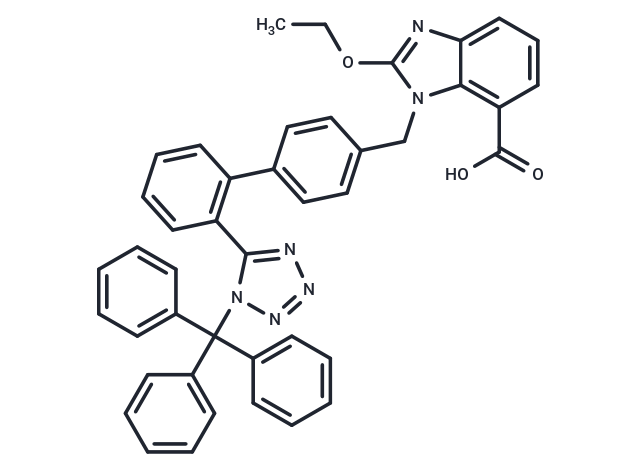
Trityl candesartan
CAS No. 139481-72-4
Trityl candesartan( —— )
Catalog No. M35878 CAS No. 139481-72-4
Trityl candesartan is a crucial intermediate used in the synthesis of Candesartan and Candesartan cilexetil, which are angiotensin II receptor antagonists.
Purity : >98% (HPLC)
 COA
Datasheet
HNMR
HPLC
MSDS
Handing Instructions
COA
Datasheet
HNMR
HPLC
MSDS
Handing Instructions
| Size | Price / USD | Stock | Quantity |
| 100MG | 36 | In Stock |


|
| 200MG | Get Quote | In Stock |
|
| 500MG | 89 | In Stock |
|
| 1G | 128 | In Stock |
|
Biological Information
-
Product NameTrityl candesartan
-
NoteResearch use only, not for human use.
-
Brief DescriptionTrityl candesartan is a crucial intermediate used in the synthesis of Candesartan and Candesartan cilexetil, which are angiotensin II receptor antagonists.
-
DescriptionTrityl candesartan is a crucial intermediate used in the synthesis of Candesartan and Candesartan cilexetil, which are angiotensin II receptor antagonists.
-
In Vitro——
-
In Vivo——
-
Synonyms——
-
PathwayOthers
-
TargetOther Targets
-
RecptorOthers
-
Research Area——
-
Indication——
Chemical Information
-
CAS Number139481-72-4
-
Formula Weight682.77
-
Molecular FormulaC43H34N6O3
-
Purity>98% (HPLC)
-
Solubility——
-
SMILESCCOC1=NC2=CC=CC(C(O)=O)=C2N1CC1=CC=C(C=C1)C1=C(C=CC=C1)C1=NN=NN1C(C1=CC=CC=C1)(C1=CC=CC=C1)C1=CC=CC=C1
-
Chemical Name——
Shipping & Storage Information
-
Storage(-20℃)
-
ShippingWith Ice Pack
-
Stability≥ 2 years
Reference
molnova catalog



related products
-
Glycozolinine
Glycozolinine (Glycozolinol) is a Iridoids product that can be isolated from the herbs of Duranta repens.
-
HBVpol502, HBV polym...
HBVpol502, HBV polymerase (502 - 510)
-
Gigantol(Dendropheno...
Gigantol(Dendrophenol) is isolated from the stems of Dendrobium candidum.
