


 Cart
Cart
 sales@molnova.com


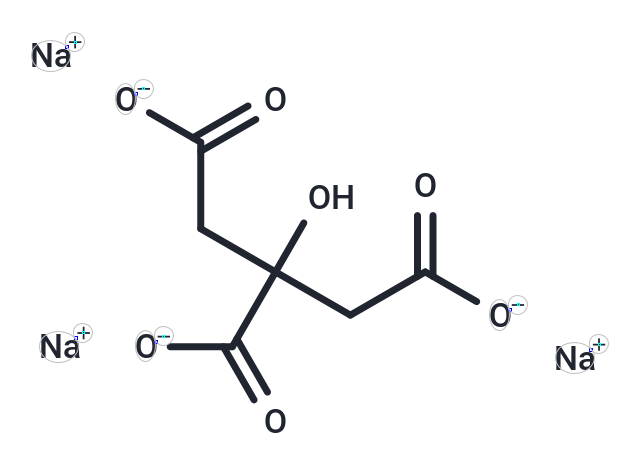
Sodium citrate
CAS No. 68-04-2
Sodium citrate( —— )
Catalog No. M35842 CAS No. 68-04-2
Sodium citrate (Natrocitral) is the sodium salt of citric acid.Citric acid trisodium induces apoptosis and cell cycle arrest at G2/M phase and S phase.
Purity : >98% (HPLC)
 COA
Datasheet
HNMR
HPLC
MSDS
Handing Instructions
COA
Datasheet
HNMR
HPLC
MSDS
Handing Instructions
| Size | Price / USD | Stock | Quantity |
| 100MG | Get Quote | In Stock |


|
| 200MG | Get Quote | In Stock |
|
| 500MG | 38 | In Stock |
|
| 1G | 45 | In Stock |
|
Biological Information
-
Product NameSodium citrate
-
NoteResearch use only, not for human use.
-
Brief DescriptionSodium citrate (Natrocitral) is the sodium salt of citric acid.Citric acid trisodium induces apoptosis and cell cycle arrest at G2/M phase and S phase.
-
DescriptionCitric acid trisodium is a natural preservative and food tartness enhancer. Citric acid trisodium induces apoptosis and cell cycle arrest at G2/M phase and S phase. Citric acid trisodium cause oxidative damage of the liver by means of the decrease of antioxidative enzyme activities. Citric acid trisodium causes renal toxicity in mice.
-
In VitroCitric acid trisodium (0-12.5 mM; 24 h) shows antiproliferative activity in a dose dependent manner.Citric acid trisodium (12.5 mM; 72 h) induces apoptosis and cell cycle arrest at G2/M phase and S phase in a dosedependent manner.Citric acid trisodium (12.5 mM; 48 h) increases the expression of FAS, BAX, BID, AIF, EndoG, cytochrome c, PARP, GADD153, GRP78 and caspase-3, -8, -9, and decreases of BCL-2 and BCL-Xl..Cell Viability Assay Cell Line:HaCaT cells Concentration:0, 2.5, 5, 7.5, 10, 12.5 mM Incubation Time:24 h Result:Inhibited the cell viability in a dose dependent manner.Cell Cycle Analysis Cell Line:HaCaT cells Concentration:12.5 mM Incubation Time:0, 12, 24, 48, 72 h Result:Induced apoptosis and cell cycle arrest at G2/M phase and S phase in a dosedependent manner.Western Blot Analysis Cell Line:HaCaT cells Concentration:12.5 mM Incubation Time:12, 24, 48 h Result:Increased the expression of FAS, BAX, BID, AIF, EndoG, cytochrome c, PARP, GADD153, GRP78 and caspase-3, -8, -9, and decreased of BCL-2 and BCL-Xl.
-
In VivoCitric acid trisodium (120, 240, and 480 mg/kg; i.p.) significantly decreases GSH-Px activity and induces an increase in the MDA (malonyldialdehyde) levels in mouse liver.Citric acid trisodium (120, 240, and 480 mg/kg; i.p.) induces apoptosis by increases caspase-3 activity in a dose-dependent manner in mouse hepatocytes.Citric acid trisodium (120, 240, and 480 mg/kg; i.p.; weekly for 3 weeks) causes renal toxicity in mice.Animal Model:20 g male Kunming mice Dosage:120, 240, 480 mg/kg Administration:I.p.; weekly for 3 weeks Result:T-SOD and GSH-Px activities in the treated groups decreased with increasing doses of citric acid, NOS activity tended to increase, and H2O2 and MDA contents gradually decreased.
-
Synonyms——
-
PathwayOthers
-
TargetOther Targets
-
RecptorOthers
-
Research Area——
-
Indication——
Chemical Information
-
CAS Number68-04-2
-
Formula Weight258.07
-
Molecular FormulaC6H5Na3O7
-
Purity>98% (HPLC)
-
SolubilityIn Vitro:?H2O : 50 mg/mL (193.75 mM; Ultrasonic)
-
SMILESC(C(=O)[O-])C(CC(=O)[O-])(C(=O)[O-])O.[Na+].[Na+].[Na+]
-
Chemical Name——
Shipping & Storage Information
-
Storage(-20℃)
-
ShippingWith Ice Pack
-
Stability≥ 2 years
Reference
1. Chen X, et al. Study on injury effect of food additive citric acid on liver tissue in mice. Cytotechnology. 2014 Mar;66(2):275-82.?
molnova catalog



related products
-
PZ-II-029
PZ-II-029 is a modulator of α6β3γ2-selective GABAA channel.
-
Neoolivil
Neoolivil
-
Androstenediol
5-Androstenediol is an analytical reference standard categorized as an anabolic androgenic steroid.
