


 Cart
Cart
 sales@molnova.com


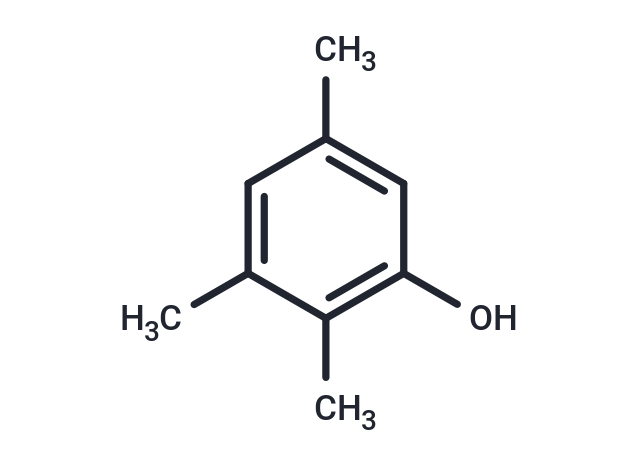
2,3,5-Trimethylphenol
CAS No. 697-82-5
2,3,5-Trimethylphenol( —— )
Catalog No. M35818 CAS No. 697-82-5
2,3,5-Trimethylphenol (Isopseudocumenol) is a antiproliferative agent, pGI50= 0.36 to T. pyriformis.
Purity : >98% (HPLC)
 COA
Datasheet
HNMR
HPLC
MSDS
Handing Instructions
COA
Datasheet
HNMR
HPLC
MSDS
Handing Instructions
| Size | Price / USD | Stock | Quantity |
| 1 mL x 10 mM in DMSO | 28 | In Stock |


|
| 100MG | Get Quote | In Stock |
|
| 200MG | Get Quote | In Stock |
|
| 500MG | Get Quote | In Stock |
|
| 1G | Get Quote | In Stock |
|
Biological Information
-
Product Name2,3,5-Trimethylphenol
-
NoteResearch use only, not for human use.
-
Brief Description2,3,5-Trimethylphenol (Isopseudocumenol) is a antiproliferative agent, pGI50= 0.36 to T. pyriformis.
-
Description2,3,5-Trimethylphenol is a phenolic compound.
-
In Vitro——
-
In Vivo——
-
Synonyms——
-
PathwayOthers
-
TargetOther Targets
-
RecptorOthers
-
Research Area——
-
Indication——
Chemical Information
-
CAS Number697-82-5
-
Formula Weight136.19
-
Molecular FormulaC9H12O
-
Purity>98% (HPLC)
-
SolubilityIn Vitro:?DMSO : ≥ 100 mg/mL (734.27 mM )
-
SMILESCC1=CC(O)=C(C)C(C)=C1
-
Chemical Name——
Shipping & Storage Information
-
Storage(-20℃)
-
ShippingWith Ice Pack
-
Stability≥ 2 years
Reference
1. H. Dakshinamurty, et al. Syntheses of Polymethylphenols and Their Derivatives. I.J. Org. Chem.?1962, 27, 5, 1839–1842.
molnova catalog



related products
-
Oxytocin (Syntocinon...
Oxytocin is a mammalian neurohypophysial hormone a ligand of oxytocin receptor.
-
Ganoderal A
The oxygenated sterols( 26-oxygenosterols ganoderol A, ganoderol B, ganoderal A, and ganoderic acid Y) from G. lucidum can inhibit cholesterol biosynthesis via conversion of acetate or mevalonate as a precursor of cholesterol.
-
LDC000067
LDC000067 is a highly specific and selective CDK9 inhibitor with an IC50 value of 44±10 nM.
