


 Cart
Cart
 sales@molnova.com


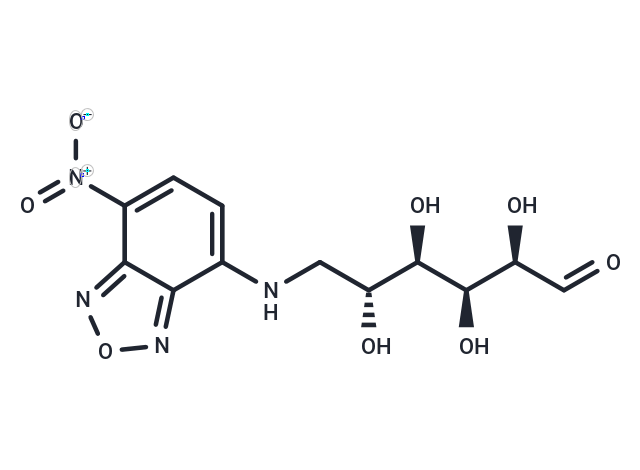
6-NBDG
CAS No. 108708-22-1
6-NBDG( —— )
Catalog No. M35804 CAS No. 108708-22-1
6-NBDG, a fluorescent glucose analogue, can be used as a fluorescent probe.6-NBDG can be used for monitoring glucose transport and uptake. 6-NBDG can be used as for detecting macrophage-rich atherosclerotic plaques.
Purity : >98% (HPLC)
 COA
Datasheet
HNMR
HPLC
MSDS
Handing Instructions
COA
Datasheet
HNMR
HPLC
MSDS
Handing Instructions
| Size | Price / USD | Stock | Quantity |
| 2MG | 530 | Get Quote |


|
| 100MG | Get Quote | Get Quote |
|
| 200MG | Get Quote | Get Quote |
|
| 500MG | Get Quote | Get Quote |
|
| 1G | Get Quote | Get Quote |
|
Biological Information
-
Product Name6-NBDG
-
NoteResearch use only, not for human use.
-
Brief Description6-NBDG, a fluorescent glucose analogue, can be used as a fluorescent probe.6-NBDG can be used for monitoring glucose transport and uptake. 6-NBDG can be used as for detecting macrophage-rich atherosclerotic plaques.
-
Description6-NBDG is a fluorescent glucose analogue, it can be used for fluorescence imaging and monitoring glucose transport and uptake. 6-NBDG can be used as a fluorescent probe for detecting macrophage-rich atherosclerotic plaques.
-
In VitroGuidelines (Following is our recommended protocol. This protocol only provides a guideline, and should be modified according to your specific needs).1. Incubate sample with RPMI (without glucose) containing a final concentration of 200 μM 6-NBDG.2. Use a curved forcep to embeds sample into the mixture, and stretches the samplet through a drop of agarose (40°C, 20 μL) places on a pre-heated (40°C) glass slide.3. Gently place another preheated glass slide on the top of sample, so that the whole sample embeds into the agarose-6-NBDG mixture.4. Take confocal images with a confocal laser scanning microscope (Ex: 471 nm, Em: 500–600 nm).
-
In Vivo——
-
Synonyms——
-
PathwayOthers
-
TargetOther Targets
-
RecptorOthers
-
Research Area——
-
Indication——
Chemical Information
-
CAS Number108708-22-1
-
Formula Weight342.26
-
Molecular FormulaC12H14N4O8
-
Purity>98% (HPLC)
-
SolubilityIn Vitro:?DMSO : 10 mg/mL (29.22 mM)
-
SMILESO=[N+]([O-])C1=CC=C(NC[C@@H](O)[C@@H](O)[C@H](O)[C@@H](O)C=O)C2=NON=C21
-
Chemical Name——
Shipping & Storage Information
-
Storage(-20℃)
-
ShippingWith Ice Pack
-
Stability≥ 2 years
Reference
1. Hansen TV, et al. Glucose Absorption by the Bacillary Band of Trichuris muris. PLoS Negl Trop Dis. 2016 Sep 2;10(9):e0004971. ?
molnova catalog



related products
-
Substance P (1-7)(TF...
Substance P (1-7)(TFA) is a fragment of the neuropeptide, substance P (SP).
-
Somatostatin- 28 (1-...
Somatostatin- 28 (1-12)
-
Pneumadin (rat)
Pneumadin, rat (PNM) is a decapeptide, which possess a potent stimulating effect on arginine-vasopressin (AVP) release. Pneumadin, rat (PNM) exerts a marked antidiuretic effect in animals with functional AVP system.
