


 Cart
 sales@molnova.com


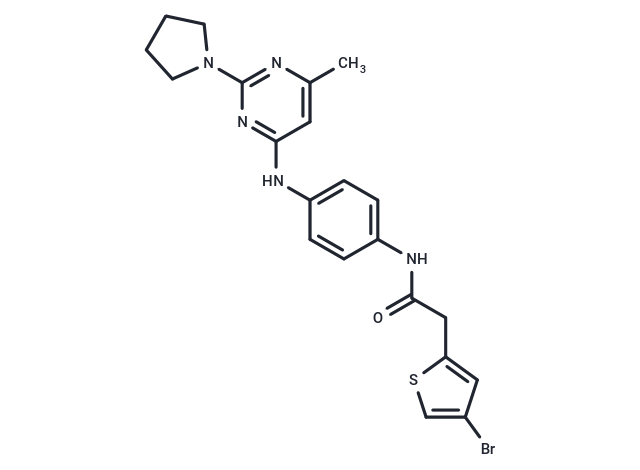
CHD1Li 6.11
CAS No. 2716890-91-2
CHD1Li 6.11( —— )
Catalog No. M35689 CAS No. 2716890-91-2
CHD1Li 6.11 is a potent inhibitor of oncogenic CHD1L, acting on the cat-CHD1L recombinant protein (IC50: 3.3 μM).
Purity : >98% (HPLC)
 COA
Datasheet
HNMR
HPLC
MSDS
Handing Instructions
| Size | Price / USD | Stock | Quantity |
| 1 mL x 10 mM in DMSO | 227 | In Stock |


|
| 5MG | 217 | In Stock |
|
| 10MG | 353 | In Stock |
|
| 25MG | 598 | In Stock |
|
| 50MG | 833 | In Stock |
|
| 100MG | 1135 | In Stock |
|
| 200MG | Get Quote | In Stock |
|
| 500MG | 2279 | In Stock |
|
| 1G | Get Quote | In Stock |
|
Biological Information
-
Product NameCHD1Li 6.11
-
NoteResearch use only, not for human use.
-
Brief DescriptionCHD1Li 6.11 is a potent inhibitor of oncogenic CHD1L, acting on the cat-CHD1L recombinant protein (IC50: 3.3 μM).
-
DescriptionCHD1Li 6.11 is a potent oncogenic CHD1L inhibitor (IC50=3.3 μM for cat-CHD1L recombinant protein).CHD1Li 6.11 is an orally bioavailable antitumor agent, significantly reducing the tumor volume of CRC xenografts generated from isolated quasi mesenchymal cells (M-phenotype), which possess enhanced tumorigenic properties.
-
In Vitro——
-
In Vivo——
-
Synonyms——
-
PathwayOthers
-
TargetOther Targets
-
RecptorOthers
-
Research Area——
-
Indication——
Chemical Information
-
CAS Number2716890-91-2
-
Formula Weight472.4
-
Molecular FormulaC21H22BrN5OS
-
Purity>98% (HPLC)
-
SolubilityIn Vitro:?DMSO : 100 mg/mL (211.69 mM; Ultrasonic )
-
SMILESCc1cc(Nc2ccc(NC(=O)Cc3cc(Br)cs3)cc2)nc(n1)N1CCCC1
-
Chemical Name——
Shipping & Storage Information
-
Storage(-20℃)
-
ShippingWith Ice Pack
-
Stability≥ 2 years
Reference
1. Prigaro BJ, et al. Design, Synthesis, and Biological Evaluation of the First Inhibitors of Oncogenic CHD1L. J Med Chem. 2022;65(5):3943-3961. ?
molnova catalog


related products
-
Thymine
Thymine is found in the nucleic acid DNA. In RNA thymine is replaced with uracil in most cases. In DNA, thymine binds to adenine via two hydrogen bonds to assist in stabilizing the nucleic acid structures.
-
Dicamba
Dicamba is a chlorinated organic herbicide. Dicamba can used to control broadleaf weeds.
-
N-Formyl-Met-Ala-Ser
N-Formyl-Met-Ala-Ser is a peptide, binds to formyl peptide receptors on neutrophils.N-Formyl-Met-Ala-Ser Peptide (fMet-Ala-Ser) binds to formyl peptide receptors on neutrophils. N-Formylmethionine-containing peptides including the most potent and known member, N-formyl-Met-Leu-Phe (FMLP or fMet-Leu-Phe) stimulate human neutrophils by a receptor-dependent mechanism.
