


 Cart
Cart
 sales@molnova.com


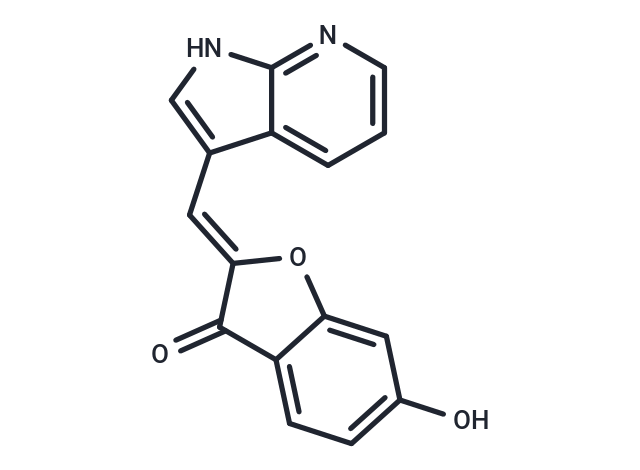
Haspin-IN-3
CAS No. 2416569-95-2
Haspin-IN-3( —— )
Catalog No. M35430 CAS No. 2416569-95-2
Haspin-IN-3 is a potent haspin inhibitor with an IC50 of 14 nM.Haspin-IN-3 has anticancer activity.
Purity : >98% (HPLC)
 COA
Datasheet
HNMR
HPLC
MSDS
Handing Instructions
COA
Datasheet
HNMR
HPLC
MSDS
Handing Instructions
| Size | Price / USD | Stock | Quantity |
| 5MG | 102 | In Stock |


|
| 10MG | 164 | In Stock |
|
| 25MG | 281 | In Stock |
|
| 50MG | 411 | In Stock |
|
| 100MG | 551 | In Stock |
|
| 200MG | 728 | In Stock |
|
| 500MG | Get Quote | In Stock |
|
| 1G | Get Quote | In Stock |
|
Biological Information
-
Product NameHaspin-IN-3
-
NoteResearch use only, not for human use.
-
Brief DescriptionHaspin-IN-3 is a potent haspin inhibitor with an IC50 of 14 nM.Haspin-IN-3 has anticancer activity.
-
DescriptionHaspin-IN-3 (compound 8l) is a potent haspin inhibitor with IC50 of 14 nM. Haspin-IN-3 has anticancer effects.
-
In Vitro——
-
In Vivo——
-
Synonyms——
-
PathwayOthers
-
TargetOther Targets
-
RecptorHaspin Kinase
-
Research Area——
-
Indication——
Chemical Information
-
CAS Number2416569-95-2
-
Formula Weight278.26
-
Molecular FormulaC16H10N2O3
-
Purity>98% (HPLC)
-
SolubilityIn Vitro:?DMSO : 25 mg/mL (89.84 mM; Ultrasonic (<60°C)
-
SMILESOc1ccc2C(=O)\C(Oc2c1)=C\c1c[nH]c2ncccc12
-
Chemical Name——
Shipping & Storage Information
-
Storage(-20℃)
-
ShippingWith Ice Pack
-
Stability≥ 2 years
Reference
1. Malikotsi A Qhobosheane, et al. Synthesis and evaluation of 7-azaindole derivatives bearing benzocycloalkanone motifs as protein kinase inhibitors. Bioorg Med Chem. 2020 Jun 1;28(11):115468. ?
molnova catalog



related products
-
Ac-tBu-Gly-tBu-Gly-A...
Ac-tBu-Gly-tBu-Gly-Asn(Me)2-Ala-AMC
-
Monascin
Monascin is a kind of azaphilonoid pigments extracted from Monascus pilosus-fermented rice (red-mold rice).
-
Exendin-4 (3-39)
Exendin-4 (3-39) is a peptide. Exendin-4 (3-39) is a truncated form of Exendin-4 that lacks the first two amino acids. Exendin-4 is a potent Glucagon-like peptide-1 receptor (GLP-1r) agonist. Exendin-4 (3-39) and Exendin-4 can be used for the research of diabetic and hypothalamic-pituitary-adrenal (HPA) axis.
