


 Cart
Cart
 sales@molnova.com


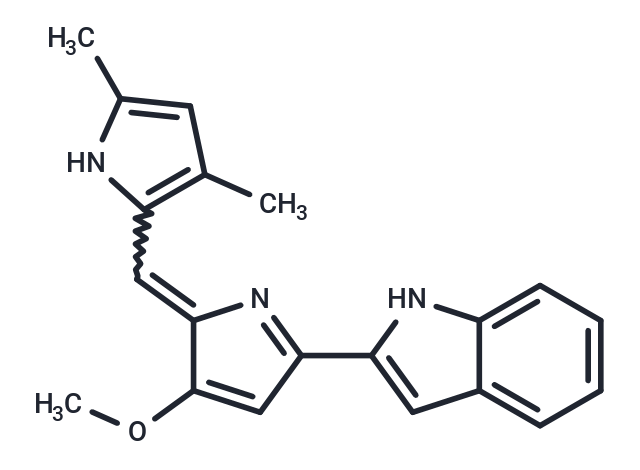
Obatoclax B
CAS No. 803712-67-6
Obatoclax B( —— )
Catalog No. M35272 CAS No. 803712-67-6
Obatoclax (GX15-070), a pan-BCL-2 family proteins inhibitor and BH3 mimetic, exhibits a binding affinity (K_i) of 220 nM for BCL-2. It promotes autophagy-dependent cell death and cyclin D1 degradation via the proteasome.
Purity : >98% (HPLC)
 COA
Datasheet
HNMR
HPLC
MSDS
Handing Instructions
COA
Datasheet
HNMR
HPLC
MSDS
Handing Instructions
| Size | Price / USD | Stock | Quantity |
| 5MG | 686 | In Stock |


|
| 10MG | 938 | In Stock |
|
| 25MG | 1444 | In Stock |
|
| 50MG | 1841 | In Stock |
|
| 100MG | 2325 | In Stock |
|
| 200MG | Get Quote | In Stock |
|
| 500MG | Get Quote | In Stock |
|
| 1G | Get Quote | In Stock |
|
Biological Information
-
Product NameObatoclax B
-
NoteResearch use only, not for human use.
-
Brief DescriptionObatoclax (GX15-070), a pan-BCL-2 family proteins inhibitor and BH3 mimetic, exhibits a binding affinity (K_i) of 220 nM for BCL-2. It promotes autophagy-dependent cell death and cyclin D1 degradation via the proteasome.
-
DescriptionObatoclax (GX15-070), a BH3 mimetic, is a pan-BCL-2 family proteins inhibitor with a Ki of 220 nM for BCL-2. Obatoclax induces autophagy-dependent cell death and targets cyclin D1 for proteasomal degradation. Obatoclax has anti-cancer and broad-spectrum antiparasitic activity.
-
In VitroObatoclax (GX15-070) inhibits BCL-2, BCL-XL, MCL-1, BCL-w, A1, and BCL-b with Ki values≈1-7 μM. Obatoclax (50-200 nM; 24-72 hours) induces a dose- and time-dependent reduction of cell numbers in all human colorectal cancer cell lines. In particular, the IC50 of cell proliferation at 72 h are 25.85, 40.69, and 40.01 nM for HCT116, HT-29, and LoVo cells, respectively. Obatoclax (400 nM; for 24 hours) induces autophagy in OSCC cells. Obatoclax (50-200 nM; for 24 hours) provokes a dose-dependent increase in the G1-phase cell populations.Obatoclax (25-200 nM; for 24 hours) indicates a marked drop in cyclin D1 levels as low as 50 nM.Obatoclax induces T286 phosphorylation-dependent or -independent cyclin D1 degradation.in HCT116 and LoVo cells, the steady-state levels of p-Cyclin D (T286) began to decline once exposed to obatoclax (200 nM; 1, 3, 6, 12, 24 hours). Obatoclax inhibits GSK3β but activates p38 MAPK, while barely affecting ERK1/2 activity in HT-29 cells. Obatoclax (50, 100, 150, 200, 250, 300, 350, 400, 450 nM) potently inhibits the clonogenic potential of oral cancer cells. Cell Proliferation Assay Cell Line:human colorectal cancer HCT116, HT-29 and LoVo cells Concentration:50, 100, 200 nM Incubation Time:24, 48, and 72 hours Result: Induced a dose- and time-dependent reduction of cell numbers.Cell Autophagy Assay Cell Line:AW8507 and SCC029B cells Concentration:400 nM Incubation Time:24 hours Result:Induced autophagy in OSCC cells.Cell Cycle Analysis Cell Line:HCT116 and HT-29 cells Concentration:50, 100, 200 nM Incubation Time:24 hours Result:Provoked a dose-dependent increase in the G1-phase cell populations. Western Blot Analysis Cell Line:HCT116, HT-29 and LoVo cells Concentration:50, 100, 200 nM Incubation Time:24 hours Result: Indicated a marked drop in cyclin D1 levels as low as 50 nM.
-
In VivoObatoclax (GX15-070; 1.15-5 mg/kg; intravenously injected; five consecutive days) exhibits potent antitumor activity in xenograft mouse models in a dose-dependent manner. Animal Model:6-8 weeks old female BALB/C nude mice bearing subcutaneous tumors Dosage:1.15, 2.5, 5 mg/kg Administration:Intravenously injected (through lateral tail vein); five consecutive days (i.e. 5 injections) Result:Exhibited potent antitumor activity in xenograft mouse models in a dose-dependent manner.
-
Synonyms——
-
PathwayOthers
-
TargetOther Targets
-
RecptorOthers
-
Research Area——
-
Indication——
Chemical Information
-
CAS Number803712-67-6
-
Formula Weight317.38
-
Molecular FormulaC20H19N3O
-
Purity>98% (HPLC)
-
Solubility——
-
SMILESC(=C1N=C(C=C1OC)C2=CC=3C(N2)=CC=CC3)C4=C(C)C=C(C)N4
-
Chemical Name——
Shipping & Storage Information
-
Storage(-20℃)
-
ShippingWith Ice Pack
-
Stability≥ 2 years
Reference
1. Or CR, et al. Obatoclax, a Pan-BCL-2 Inhibitor, Targets Cyclin D1 for Degradation to Induce Antiproliferation in Human Colorectal Carcinoma Cells. Int J Mol Sci. 2016 Dec 27;18(1).?
molnova catalog



related products
-
Shz 1
Shz 1 is a cardiogenic agent that induces phenotypic differentiation and various cardiac-specific genes including sarcomeric tropomyosin.
-
Cyclo(Ser-Pro)
From Pantoea agglomerans.
-
Ammonium Glycyrrhizi...
Ammonium Glycyrrhizinate inhibits the cytopathology and growth of several unrelated DNA/RNA viruses.
