


 Cart
Cart
 sales@molnova.com


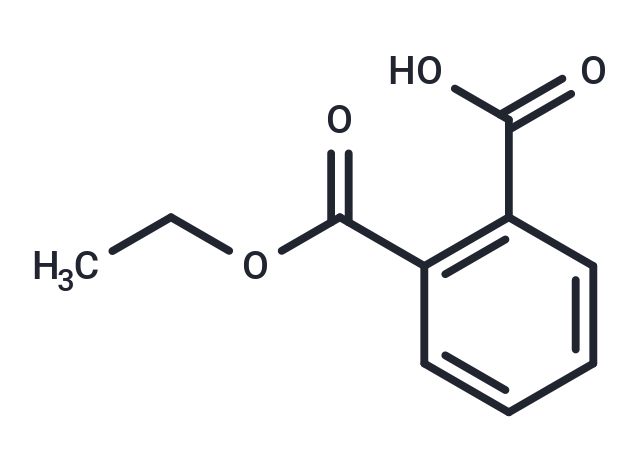
Monoethyl phthalate
CAS No. 2306-33-4
Monoethyl phthalate( —— )
Catalog No. M35162 CAS No. 2306-33-4
Monoethyl phthalate, a metabolite of diethyl phthalate, serves as a urinary biomarker for phthalate exposure and indicates potential risks of thyroid cancer and benign nodules.
Purity : >98% (HPLC)
 COA
Datasheet
HNMR
HPLC
MSDS
Handing Instructions
COA
Datasheet
HNMR
HPLC
MSDS
Handing Instructions
| Size | Price / USD | Stock | Quantity |
| 1 mL x 10 mM in DMSO | 46 | In Stock |


|
| 2MG | 29 | In Stock |
|
| 5MG | 42 | In Stock |
|
| 10MG | 65 | In Stock |
|
| 25MG | 132 | In Stock |
|
| 50MG | 184 | In Stock |
|
| 100MG | 276 | In Stock |
|
| 200MG | Get Quote | In Stock |
|
| 500MG | 682 | In Stock |
|
| 1G | Get Quote | In Stock |
|
Biological Information
-
Product NameMonoethyl phthalate
-
NoteResearch use only, not for human use.
-
Brief DescriptionMonoethyl phthalate, a metabolite of diethyl phthalate, serves as a urinary biomarker for phthalate exposure and indicates potential risks of thyroid cancer and benign nodules.
-
DescriptionMonoethyl phthalate is a metabolite of diethyl phthalate. Monoethyl phthalate acts as a urinary biomarker of phthalates exposure indicating the risks of thyroid cancer and benign nodule.
-
In Vitro——
-
In Vivo——
-
Synonyms——
-
PathwayOthers
-
TargetOther Targets
-
RecptorDrug Metabolite
-
Research Area——
-
Indication——
Chemical Information
-
CAS Number2306-33-4
-
Formula Weight194.18
-
Molecular FormulaC10H10O4
-
Purity>98% (HPLC)
-
SolubilityIn Vitro:?DMSO : 100 mg/mL (514.99 mM; Ultrasonic )
-
SMILESO=C(O)C=1C=CC=CC1C(=O)OCC
-
Chemical Name——
Shipping & Storage Information
-
Storage(-20℃)
-
ShippingWith Ice Pack
-
Stability≥ 2 years
Reference
1. Chong Liu, et al. Urinary biomarkers of phthalates exposure and risks of thyroid cancer and benign nodule. J Hazard Mater. 2020 Feb 5;383:121189.?
molnova catalog



related products
-
(3S)-3,7-dimethyloct...
(3S)-3,7-dimethyloctan-1-ol ((S)-3,7-dimethyl-1-octanol) can be used to synthesize liquid crystal compounds and nanoparticles.
-
Trans-Chrysanthemyl ...
Trans-Chrysanthemyl Alcohol is a natural product.
-
6-Hydroxycoumarin
6-Hydroxycoumarin exhibits cytotoxicity against human HL60, HCT116, COLO205 cells with activity value of 35 uM, 42 uM, 37 respectively.
