


 Cart
Cart
 sales@molnova.com


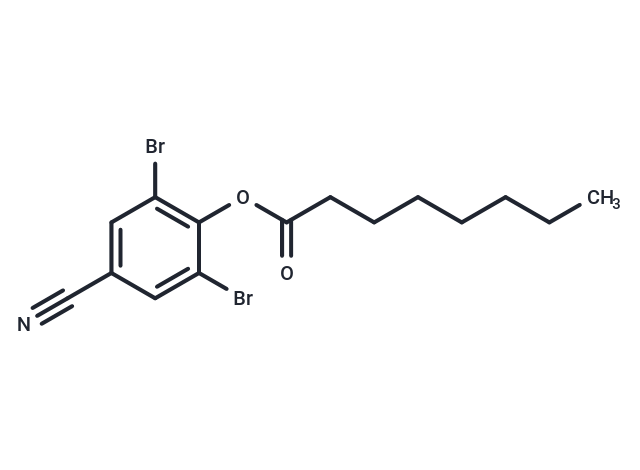
Bromoxynil octanoate
CAS No. 1689-99-2
Bromoxynil octanoate( —— )
Catalog No. M35096 CAS No. 1689-99-2
Bromoxynil octanoate is an essential herbicide for plant growth and production that induces oxidative stress, inflammation, and apoptosis in testicular tissues by modulating the NF-λB pathway.
Purity : >98% (HPLC)
 COA
Datasheet
HNMR
HPLC
MSDS
Handing Instructions
COA
Datasheet
HNMR
HPLC
MSDS
Handing Instructions
| Size | Price / USD | Stock | Quantity |
| 1 mL x 10 mM in DMSO | 42 | In Stock |


|
| 25MG | 38 | In Stock |
|
| 50MG | 60 | In Stock |
|
| 100MG | 91 | In Stock |
|
| 200MG | Get Quote | In Stock |
|
| 500MG | 221 | In Stock |
|
| 1G | Get Quote | In Stock |
|
Biological Information
-
Product NameBromoxynil octanoate
-
NoteResearch use only, not for human use.
-
Brief DescriptionBromoxynil octanoate is an essential herbicide for plant growth and production that induces oxidative stress, inflammation, and apoptosis in testicular tissues by modulating the NF-λB pathway.
-
DescriptionBromoxynil octanoate is an herbicide widely applied to maize, is potentially toxic to both animals and humans.
-
In Vitro——
-
In Vivo——
-
Synonyms——
-
PathwayOthers
-
TargetOther Targets
-
RecptorOthers
-
Research Area——
-
Indication——
Chemical Information
-
CAS Number1689-99-2
-
Formula Weight403.11
-
Molecular FormulaC15H17Br2NO2
-
Purity>98% (HPLC)
-
SolubilityIn Vitro:?DMSO : 100 mg/mL (248.07 mM; Ultrasonic )
-
SMILESN#CC1=CC(Br)=C(OC(=O)CCCCCCC)C(Br)=C1
-
Chemical Name——
Shipping & Storage Information
-
Storage(-20℃)
-
ShippingWith Ice Pack
-
Stability≥ 2 years
Reference
1. Cai T, et al. Degradation of bromoxynil octanoate by strain Acinetobacter sp. XB2 isolated from contaminated soil. Curr Microbiol. 2011;63(2):218-225.?
molnova catalog



related products
-
L-Gulose
L-Gulose is an unnatural monosaccharide. L-Gulose is the putative furanose form of L-sorbosone that exists as a syrup with a sweet taste. It is an L-hexose sugar and an intermediate in the biosynthesis of L-Ascorbate (vitamin C).
-
Hancinone C
Hancinone C shows inhibitory activity against the platelet aggregation caused by PAF.
-
Benzamide
Benzamide, an inhibitor of poly(ADP-ribose) polymerase, is a derivative of benzoic acid.
