


 Cart
Cart
 sales@molnova.com


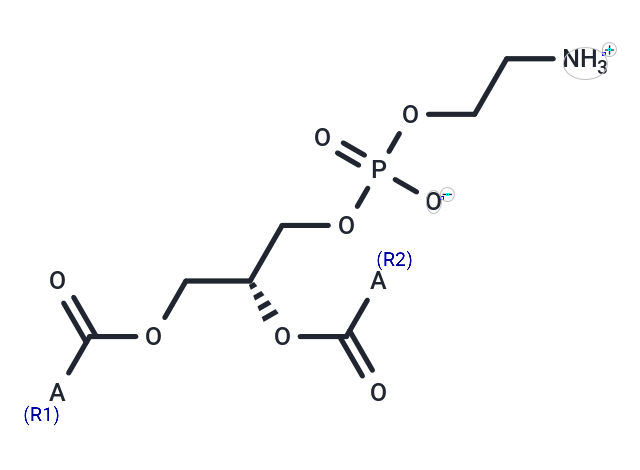
Phosphatidylethanolamine from bovine
CAS No. 90989-93-8
Phosphatidylethanolamine from bovine( —— )
Catalog No. M35011 CAS No. 90989-93-8
Phosphatidylethanolamines (bovine) are a mixture of phosphatidylethanolamines isolated from bovine brain with different fatty acyl groups at the sn-1 and sn-2 positions.
Purity : >98% (HPLC)
 COA
Datasheet
HNMR
HPLC
MSDS
Handing Instructions
COA
Datasheet
HNMR
HPLC
MSDS
Handing Instructions
| Size | Price / USD | Stock | Quantity |
| 5MG | 68 | In Stock |


|
| 10MG | 107 | In Stock |
|
| 25MG | 217 | In Stock |
|
| 50MG | 319 | In Stock |
|
| 100MG | 481 | In Stock |
|
| 200MG | Get Quote | In Stock |
|
| 500MG | 1079 | In Stock |
|
| 1G | Get Quote | In Stock |
|
Biological Information
-
Product NamePhosphatidylethanolamine from bovine
-
NoteResearch use only, not for human use.
-
Brief DescriptionPhosphatidylethanolamines (bovine) are a mixture of phosphatidylethanolamines isolated from bovine brain with different fatty acyl groups at the sn-1 and sn-2 positions.
-
DescriptionPhosphatidylethanolamine is a phospholipid. It is used for preparation of vesicle suspensions, commonly called liposomes, or as monolayers.
-
In Vitro——
-
In Vivo——
-
Synonyms——
-
PathwayOthers
-
TargetOther Targets
-
RecptorOthers
-
Research Area——
-
Indication——
Chemical Information
-
CAS Number90989-93-8
-
Formula Weight744
-
Molecular FormulaC41H78NO8P (for oleoyl)
-
Purity>98% (HPLC)
-
SolubilityIn Vitro:?Ethanol : 50 mg/mL (Ultrasonic))
-
SMILESO=P([O-])(OCC[NH3+])OC[C@@H](COC([R1])=O)OC([R2])=O
-
Chemical Name——
Shipping & Storage Information
-
Storage(-20℃)
-
ShippingWith Ice Pack
-
Stability≥ 2 years
Reference
molnova catalog



related products
-
L-JNKI-1
L-JNKI-1 is a cell-permeable peptide inhibitor specific for JNK, it has been shown to effectively inhibit JNK activity in in vivo studies.
-
He-LWamide II
He-LWamide II
-
2-Isopropyl Thioxant...
2-Isopropyl Thioxanthone has potential anti-estrogenic and anti-androgenic properties.
