


 Cart
Cart
 sales@molnova.com


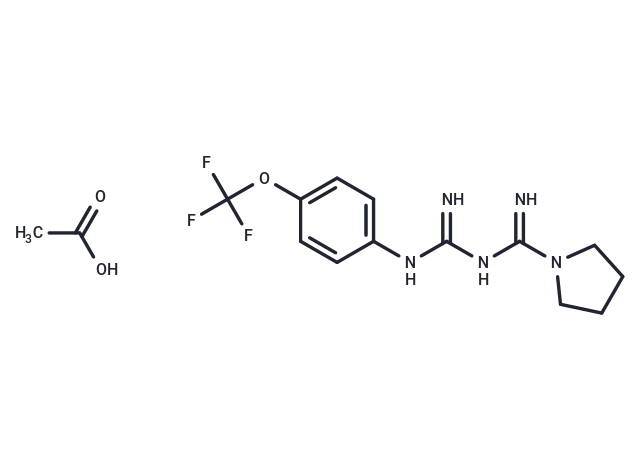
IM-156 acetate
CAS No. 2043654-54-0
IM-156 acetate( —— )
Catalog No. M34839 CAS No. 2043654-54-0
IM-156 acetate, an activator of NADH dehydrogenase (IC50=2.2 μM) and AMP-activated protein kinase alpha (AMPKα), is an orally available and bioavailable inhibitor of mitochondrial oxidative phosphorylation (OxPhos).
Purity : >98% (HPLC)
 COA
Datasheet
HNMR
HPLC
MSDS
Handing Instructions
COA
Datasheet
HNMR
HPLC
MSDS
Handing Instructions
| Size | Price / USD | Stock | Quantity |
| 2MG | 76 | In Stock |


|
| 100MG | Get Quote | In Stock |
|
| 200MG | Get Quote | In Stock |
|
| 500MG | Get Quote | In Stock |
|
| 1G | Get Quote | In Stock |
|
Biological Information
-
Product NameIM-156 acetate
-
NoteResearch use only, not for human use.
-
Brief DescriptionIM-156 acetate, an activator of NADH dehydrogenase (IC50=2.2 μM) and AMP-activated protein kinase alpha (AMPKα), is an orally available and bioavailable inhibitor of mitochondrial oxidative phosphorylation (OxPhos).
-
DescriptionIM-156 acetate, an activator of NADH dehydrogenase (IC50=2.2 μM) and AMP-activated protein kinase alpha (AMPKα), is an orally available and bioavailable inhibitor of mitochondrial oxidative phosphorylation (OxPhos).IM-156 acetate increases AMPKα activity and inhibits chlorhexadiene-induced peritoneal fibrosis and inhibit tumor growth in rats .
-
In Vitro——
-
In Vivo——
-
Synonyms——
-
PathwayOthers
-
TargetOther Targets
-
RecptorOthers
-
Research Area——
-
Indication——
Chemical Information
-
CAS Number2043654-54-0
-
Formula Weight375.35
-
Molecular FormulaC15H20F3N5O3
-
Purity>98% (HPLC)
-
Solubility——
-
SMILESO=C(O)C.FC(F)(F)OC1=CC=C(C=C1)NC(=N)NC(=N)N2CCCC2
-
Chemical Name——
Shipping & Storage Information
-
Storage(-20℃)
-
ShippingWith Ice Pack
-
Stability≥ 2 years
Reference
molnova catalog



related products
-
DSP-4 hydrochloride
DSP-4 hydrochloride (Neurotoxin DSP 4 hydrochloride) can be used for the temporary selective degradation of the central and peripheral noradrenergic neurons, mainly those from the locus coeruleus (LC).
-
MBS Crosslinker
MBS Crosslinker (MBS protein crosslinker) is a crosslinker that can be used as an asymmetric spacer.
-
Acetyl-(Nle4,Gln5,D-...
Acetyl-(Nle4,Gln5,D-Phe7,D-Trp9)-α-MSH (4-10) amide
