


 Cart
Cart
 sales@molnova.com


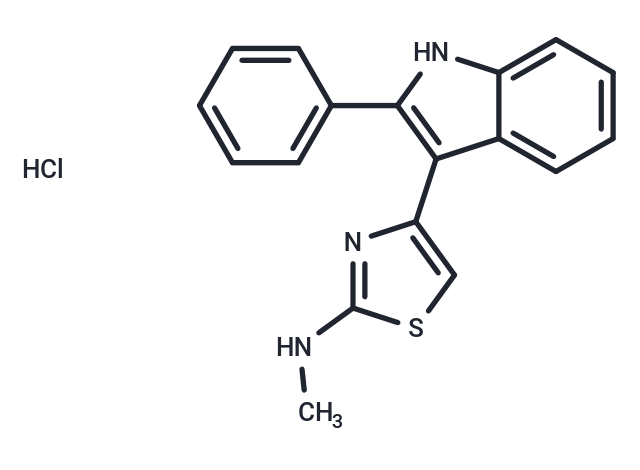
VA-K-14 hydrochloride
CAS No. 1171341-19-7
VA-K-14 hydrochloride( —— )
Catalog No. M34462 CAS No. 1171341-19-7
VA-K-14 hydrochloride(VAK14 HCl) is a selective thyrotropin receptor (TSHR) antagonist (IC50= 12.3 μM) that inhibits TSHR stimulation by serum and monoclonal TSHR-stimulating antibodies from patients with GD and abrogates TSHR signaling.
Purity : >98% (HPLC)
 COA
Datasheet
HNMR
HPLC
MSDS
Handing Instructions
COA
Datasheet
HNMR
HPLC
MSDS
Handing Instructions
| Size | Price / USD | Stock | Quantity |
| 5MG | 121 | In Stock |


|
| 10MG | 186 | In Stock |
|
| 25MG | 376 | In Stock |
|
| 50MG | 600 | In Stock |
|
| 100MG | 918 | In Stock |
|
| 200MG | Get Quote | In Stock |
|
| 500MG | Get Quote | In Stock |
|
| 1G | Get Quote | In Stock |
|
Biological Information
-
Product NameVA-K-14 hydrochloride
-
NoteResearch use only, not for human use.
-
Brief DescriptionVA-K-14 hydrochloride(VAK14 HCl) is a selective thyrotropin receptor (TSHR) antagonist (IC50= 12.3 μM) that inhibits TSHR stimulation by serum and monoclonal TSHR-stimulating antibodies from patients with GD and abrogates TSHR signaling.
-
DescriptionVA-K-14 hydrochloride is a specific thyroid-stimulating hormone receptor (TSHR) antagonist (IC50= 12.3 μM).
-
In Vitro——
-
In Vivo——
-
Synonyms——
-
PathwayOthers
-
TargetOther Targets
-
RecptorTSH Receptor
-
Research Area——
-
Indication——
Chemical Information
-
CAS Number1171341-19-7
-
Formula Weight341.86
-
Molecular FormulaC18H16ClN3S
-
Purity>98% (HPLC)
-
SolubilityIn Vitro:?DMSO : 50 mg/mL (146.26 mM; Ultrasonic )
-
SMILESCl.CNc1nc(cs1)-c1c([nH]c2ccccc12)-c1ccccc1
-
Chemical Name——
Shipping & Storage Information
-
Storage(-20℃)
-
ShippingWith Ice Pack
-
Stability≥ 2 years
Reference
1. Latif R, et al. TSH Receptor Signaling Abrogation by a Novel Small Molecule. Front Endocrinol (Lausanne). 2016;7:130. Published 2016 Sep 27. ?
molnova catalog



related products
-
Kisspeptin-13 (4-13)...
Kisspeptin-13 (4-13) (human)
-
N-Boc-4-pentyne-1-am...
N-Boc-4-pentyne-1-amine is a PROTAC linker, which refers to the alkyl chain composition. N-Boc-4-pentyne-1-amine can be used in the synthesis of the PROTAC MG-277.
-
Gastrin Releasing Pe...
Gastrin Releasing Peptide (1-16), human
