


 Cart
Cart
 sales@molnova.com


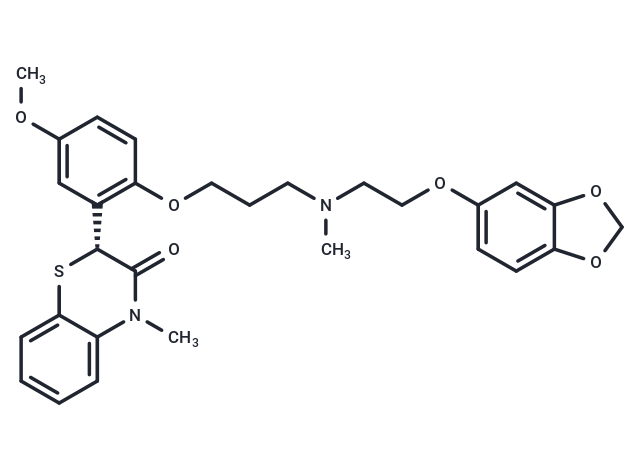
Sesamodil
CAS No. 116476-13-2
Sesamodil( —— )
Catalog No. M34420 CAS No. 116476-13-2
Sesamodil (SD 3211) is a novel calcium antagonist that can be used to study hypertension.
Purity : >98% (HPLC)
 COA
Datasheet
HNMR
HPLC
MSDS
Handing Instructions
COA
Datasheet
HNMR
HPLC
MSDS
Handing Instructions
| Size | Price / USD | Stock | Quantity |
| 5MG | 586 | In Stock |


|
| 10MG | 718 | In Stock |
|
| 25MG | 943 | In Stock |
|
| 100MG | Get Quote | In Stock |
|
| 200MG | Get Quote | In Stock |
|
| 500MG | Get Quote | In Stock |
|
| 1G | Get Quote | In Stock |
|
Biological Information
-
Product NameSesamodil
-
NoteResearch use only, not for human use.
-
Brief DescriptionSesamodil (SD 3211) is a novel calcium antagonist that can be used to study hypertension.
-
DescriptionSesamodil (SD 3211) is a novel calcium antagonist that can be used to study hypertension.
-
In Vitro——
-
In Vivo——
-
Synonyms——
-
PathwayGPCR/G Protein
-
TargetCalcium Channel
-
RecptorCalcium Channel
-
Research Area——
-
Indication——
Chemical Information
-
CAS Number116476-13-2
-
Formula Weight536.64
-
Molecular FormulaC29H32N2O6S
-
Purity>98% (HPLC)
-
Solubility——
-
SMILESO(CCCN(CCOC=1C=C2C(=CC1)OCO2)C)C3=C(C=C(OC)C=C3)[C@H]4SC=5C(N(C)C4=O)=CC=CC5
-
Chemical Name——
Shipping & Storage Information
-
Storage(-20℃)
-
ShippingWith Ice Pack
-
Stability≥ 2 years
Reference
molnova catalog



related products
-
Ruthenium Red
Ruthenium Red is a polycationic dye widely used for electron microscopy (EM) of cells, tissues and vegetative bacteria.?
-
Synta-66
A potent, selective CRAC channel Orai1 blocker with IC50 of 3 uM.
-
NNC 55-0396
A potent and selective T-type calcium channel antagonist that blocks recombinant alpha(1)G T-type channels in human embryonic kidney 293 cellswith IC50 of 7 uM.
