


 Cart
Cart
 sales@molnova.com


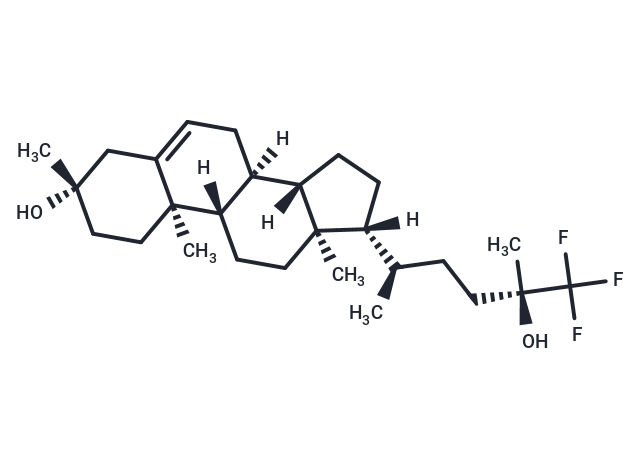
BDBM50597431
CAS No. 1629853-49-1
BDBM50597431( —— )
Catalog No. M34374 CAS No. 1629853-49-1
BDBM50597431 is an NMDA receptor modulator that may have can be used to study Alzheimer's disease and Parkinson's syndrome.
Purity : >98% (HPLC)
 COA
Datasheet
HNMR
HPLC
MSDS
Handing Instructions
COA
Datasheet
HNMR
HPLC
MSDS
Handing Instructions
| Size | Price / USD | Stock | Quantity |
| 5MG | 409 | In Stock |


|
| 10MG | 604 | In Stock |
|
| 25MG | 938 | In Stock |
|
| 50MG | 1265 | In Stock |
|
| 100MG | 1702 | In Stock |
|
| 200MG | Get Quote | In Stock |
|
| 500MG | Get Quote | In Stock |
|
| 1G | Get Quote | In Stock |
|
Biological Information
-
Product NameBDBM50597431
-
NoteResearch use only, not for human use.
-
Brief DescriptionBDBM50597431 is an NMDA receptor modulator that may have can be used to study Alzheimer's disease and Parkinson's syndrome.
-
DescriptionBDBM50597431 is an NMDA receptor modulator that may have can be used to study Alzheimer's disease and Parkinson's syndrome.
-
In Vitro——
-
In Vivo——
-
Synonyms——
-
PathwayMembrane Transporter/Ion Channel
-
TargetNMDAR
-
RecptorNMDAR
-
Research Area——
-
Indication——
Chemical Information
-
CAS Number1629853-49-1
-
Formula Weight456.62
-
Molecular FormulaC27H43F3O2
-
Purity>98% (HPLC)
-
Solubility——
-
SMILESC[C@@]12[C@@]3([C@]([C@]4([C@](C)(CC3)[C@@]([C@@H](CC[C@@](C(F)(F)F)(C)O)C)(CC4)[H])[H])(CC=C1C[C@@](C)(O)CC2)[H])[H]
-
Chemical Name——
Shipping & Storage Information
-
Storage(-20℃)
-
ShippingWith Ice Pack
-
Stability≥ 2 years
Reference
molnova catalog



related products
-
Arcaine sulfate
Arcaine sulfate salt (1,4-diguanidinobutane), a polyamine, is an antagonist of the polyamine binding site of the N-methyl-d-aspartate (NMDA) receptor. Arcaine, an agmatine analog, along with ifenprodil, might have a possibility for therapeutic management in epileptic disorders.
-
Selfotel
CGS 19755 is a selective, competitive NMDA antagonist that inhibits [3H]-3-(2-carboxypiperazin-4-yl)propyl-1-phosphonic acid binding to NMDA-type receptors with IC50 of 50 nM.
-
1-Aminocyclobutaneca...
1-Aminocyclobutanecarboxylic acid is a NMDA receptor partial agonist. 1-Aminocyclobutanecarboxylic acid act at the glycine site, NR1.
