


 Cart
Cart
 sales@molnova.com


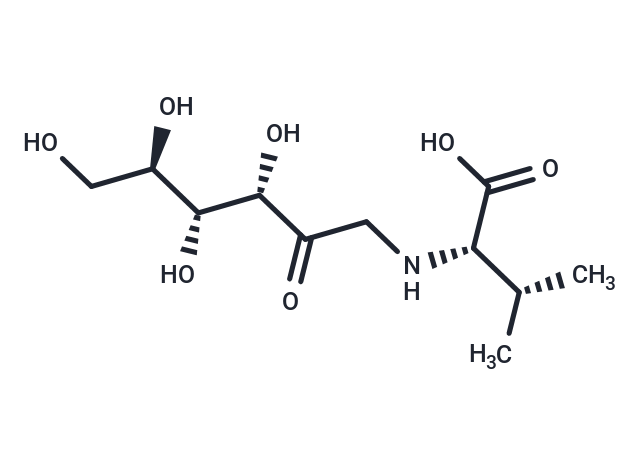
Fructosylvaline
CAS No. 10003-64-2
Fructosylvaline( —— )
Catalog No. M34078 CAS No. 10003-64-2
Fructosylvaline(Fru-val) is present in miso, white wine and sake and has been associated with oxidative browning of white wine and sake.
Purity : >98% (HPLC)
 COA
Datasheet
HNMR
HPLC
MSDS
Handing Instructions
COA
Datasheet
HNMR
HPLC
MSDS
Handing Instructions
| Size | Price / USD | Stock | Quantity |
| 5MG | 188 | In Stock |


|
| 10MG | 278 | In Stock |
|
| 25MG | 506 | In Stock |
|
| 100MG | Get Quote | In Stock |
|
| 200MG | Get Quote | In Stock |
|
| 500MG | Get Quote | In Stock |
|
| 1G | Get Quote | In Stock |
|
Biological Information
-
Product NameFructosylvaline
-
NoteResearch use only, not for human use.
-
Brief DescriptionFructosylvaline(Fru-val) is present in miso, white wine and sake and has been associated with oxidative browning of white wine and sake.
-
DescriptionFructosylvaline(Fru-val) is present in miso, white wine and sake and has been associated with oxidative browning of white wine and sake.
-
In Vitro——
-
In Vivo——
-
Synonyms——
-
PathwayOthers
-
TargetOther Targets
-
RecptorOthers
-
Research Area——
-
Indication——
Chemical Information
-
CAS Number10003-64-2
-
Formula Weight279.29
-
Molecular FormulaC11H21NO7
-
Purity>98% (HPLC)
-
Solubility——
-
SMILES[C@H](NCC([C@H]([C@@H]([C@@H](CO)O)O)O)=O)([C@H](C)C)C(O)=O
-
Chemical Name——
Shipping & Storage Information
-
Storage(-20℃)
-
ShippingWith Ice Pack
-
Stability≥ 2 years
Reference
molnova catalog



related products
-
Dipropofol
Dipropofol (4,4-Bis(2,6-di-isopropylphenol)) is a small molecule GABAA receptor agonist that can be used to study epilepsy.
-
Xphos
XPhos (2-(Dicyclohexylphosphino)-2',4',6'-triisopropylbiphenyl) is a biochemical reagent that can be used as a biological material or organic compound for life science related research.
-
Maltopentaose
Maltopentaose is a maltooligosaccharide that is used for research and diagnostic purposes. They can also be used in nutrients and healthcare.
