


 Cart
Cart
 sales@molnova.com


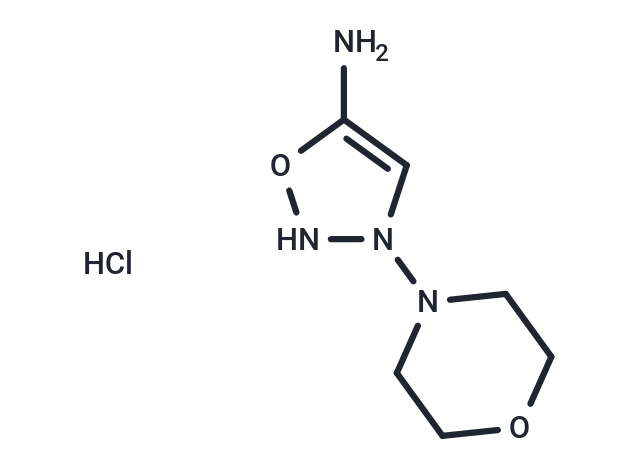
Linsidomine hydrochloride
CAS No. 16142-27-1
Linsidomine hydrochloride( —— )
Catalog No. M33929 CAS No. 16142-27-1
Linsidomine hydrochloride (SIN-1 chloride) is considered as a metabolite of moxidomine, with vasodilation, inhibition of platelet aggregation, and antiangina activity.
Purity : >98% (HPLC)
 COA
Datasheet
HNMR
HPLC
MSDS
Handing Instructions
COA
Datasheet
HNMR
HPLC
MSDS
Handing Instructions
| Size | Price / USD | Stock | Quantity |
| 1 mL x 10 mM in DMSO | 51 | In Stock |


|
| 2MG | 29 | In Stock |
|
| 5MG | 46 | In Stock |
|
| 10MG | 77 | In Stock |
|
| 25MG | 148 | In Stock |
|
| 100MG | Get Quote | In Stock |
|
| 200MG | Get Quote | In Stock |
|
| 500MG | Get Quote | In Stock |
|
| 1G | Get Quote | In Stock |
|
Biological Information
-
Product NameLinsidomine hydrochloride
-
NoteResearch use only, not for human use.
-
Brief DescriptionLinsidomine hydrochloride (SIN-1 chloride) is considered as a metabolite of moxidomine, with vasodilation, inhibition of platelet aggregation, and antiangina activity.
-
DescriptionSIN-1 (chloride) is the active metabolite of molsidomine. SIN-1 (chloride) exhibits potent vasorelaxant effect and inhibition of platelet aggregation. SIN-1 (chloride) decreases myocardial necrosis and reperfusion-induced endothelial dysfunction in models of myocardial ischemia-reperfusion.
-
In Vitro——
-
In Vivo——
-
Synonyms——
-
PathwayOthers
-
TargetOther Targets
-
RecptorDrug Metabolite
-
Research Area——
-
Indication——
Chemical Information
-
CAS Number16142-27-1
-
Formula Weight206.63
-
Molecular FormulaC6H11ClN4O2
-
Purity>98% (HPLC)
-
SolubilityIn Vitro:?H2O : 50 mg/mL (241.98 mM; Ultrasonic)DMSO : 25 mg/mL (120.99 mM; Ultrasonic (<60°C)
-
SMILESCl.NC1=CN(NO1)N1CCOCC1
-
Chemical Name——
Shipping & Storage Information
-
Storage(-20℃)
-
ShippingWith Ice Pack
-
Stability≥ 2 years
Reference
1. Nishikawa M,et al. Inhibition of platelet aggregation and stimulation of guanylate cyclase by an antianginal agent molsidomine and its metabolites. J Pharmacol Exp Ther. 1982 Jan;220(1):183-90. ?
molnova catalog



related products
-
DLinDAP
DLinDAP (D-LinDAP) is an ionizable cationic lipid used for SiRNA delivery.
-
Prosaptide, wild typ...
Prosaptide, wild type
-
methyl 5-bromo-1H-py...
methyl 5-bromo-1H-pyrrole-2-carboxylate is a marine derived natural products found in Lissodendoryx sp.
