


 Cart
Cart
 sales@molnova.com


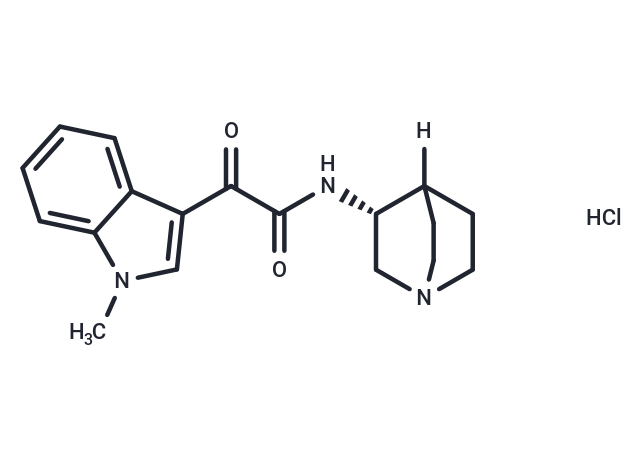
RS 56812 hydrochloride
CAS No. 143339-12-2
RS 56812 hydrochloride( —— )
Catalog No. M33916 CAS No. 143339-12-2
RS 56812 hydrochloride is a 5-HT3 receptor antagonist and agonist, and may be used in the study of cognitive disorders.
Purity : >98% (HPLC)
 COA
Datasheet
HNMR
HPLC
MSDS
Handing Instructions
COA
Datasheet
HNMR
HPLC
MSDS
Handing Instructions
| Size | Price / USD | Stock | Quantity |
| 2MG | 79 | In Stock |


|
| 5MG | 129 | In Stock |
|
| 10MG | 188 | In Stock |
|
| 25MG | 440 | In Stock |
|
| 100MG | Get Quote | In Stock |
|
| 200MG | Get Quote | In Stock |
|
| 500MG | Get Quote | In Stock |
|
| 1G | Get Quote | In Stock |
|
Biological Information
-
Product NameRS 56812 hydrochloride
-
NoteResearch use only, not for human use.
-
Brief DescriptionRS 56812 hydrochloride is a 5-HT3 receptor antagonist and agonist, and may be used in the study of cognitive disorders.
-
DescriptionRS 56812 hydrochloride is a 5-HT3 receptor antagonist and agonist, and may be used in the study of cognitive disorders.
-
In Vitro——
-
In Vivo——
-
Synonyms——
-
PathwayGPCR/G Protein
-
Target5-HT Receptor
-
Recptor5-HT Receptor
-
Research Area——
-
Indication——
Chemical Information
-
CAS Number143339-12-2
-
Formula Weight347.84
-
Molecular FormulaC18H22ClN3O2
-
Purity>98% (HPLC)
-
Solubility——
-
SMILESC(C(N[C@@H]1C2(CCN(C1)CC2)[H])=O)(=O)C=3C=4C(N(C)C3)=CC=CC4.Cl
-
Chemical Name——
Shipping & Storage Information
-
Storage(-20℃)
-
ShippingWith Ice Pack
-
Stability≥ 2 years
Reference
molnova catalog



related products
-
Revexepride
Revexepride (SSP 002358;SPD-557) potent, highly selective 5-HT4 receptor agonist for the treatment of gastroesophageal reflux disease.
-
ML 10302 hydrochlori...
ML 10302 hydrochloride is a specific agonist 5-HT4 and binds 5-HT receptors with Kis of 1.07 nM and 782 nM for 5-HT4 and 5-HT3.
-
LY 272015 hydrochlor...
LY 272015 hydrochloride is an orally active and selective 5-HT2B receptor antagonist that displays antihypertensive effects in DOCA-salt hypertensive rats.
