


 Cart
Cart
 sales@molnova.com


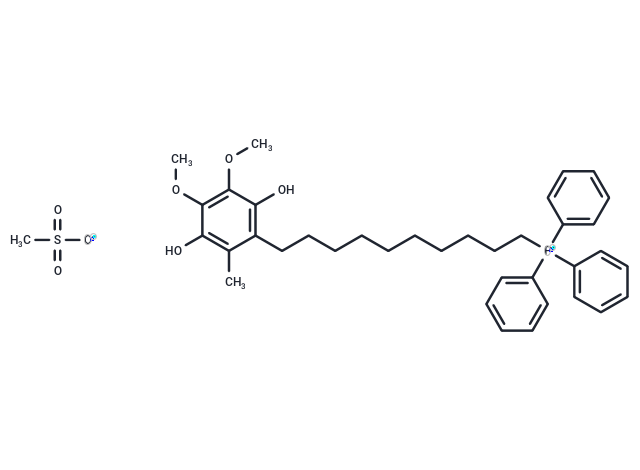
Mitoquinol mesylate
CAS No. 845959-55-9
Mitoquinol mesylate( —— )
Catalog No. M33808 CAS No. 845959-55-9
Mitoquinol, a ubiquinone derivative, specifically accumulates in mitochondria due to the covalent attachment of the cation triphenylphosphonium.
Purity : >98% (HPLC)
 COA
Datasheet
HNMR
HPLC
MSDS
Handing Instructions
COA
Datasheet
HNMR
HPLC
MSDS
Handing Instructions
| Size | Price / USD | Stock | Quantity |
| 5MG | 464 | Get Quote |


|
| 10MG | 851 | Get Quote |
|
| 100MG | Get Quote | Get Quote |
|
| 200MG | Get Quote | Get Quote |
|
| 500MG | Get Quote | Get Quote |
|
| 1G | Get Quote | Get Quote |
|
Biological Information
-
Product NameMitoquinol mesylate
-
NoteResearch use only, not for human use.
-
Brief DescriptionMitoquinol, a ubiquinone derivative, specifically accumulates in mitochondria due to the covalent attachment of the cation triphenylphosphonium.
-
DescriptionMitoquinol, a ubiquinone derivative, specifically accumulates in mitochondria due to the covalent attachment of the cation triphenylphosphonium. Mitoquinol is an antioxidant, protecting mitochondria from oxidative damage and preventing lipid peroxidation-induced apoptosis.
-
In Vitro——
-
In Vivo——
-
Synonyms——
-
PathwayOthers
-
TargetOther Targets
-
RecptorOthers
-
Research Area——
-
Indication——
Chemical Information
-
CAS Number845959-55-9
-
Formula Weight680.84
-
Molecular FormulaC38H49O7PS
-
Purity>98% (HPLC)
-
Solubility——
-
SMILESCS([O-])(=O)=O.COc1c(O)c(C)c(CCCCCCCCCC[P+](c2ccccc2)(c2ccccc2)c2ccccc2)c(O)c1OC
-
Chemical Name——
Shipping & Storage Information
-
Storage(-20℃)
-
ShippingWith Ice Pack
-
Stability≥ 2 years
Reference
molnova catalog



related products
-
Multicaulisin
Multicaulisin is a natural product from Morus multicaulis.
-
Magnesium sulfate
Magnesium sulfate is the preferred anticonvulsant for preventing and controlling eclamptic seizures. Additionally, it is extensively utilized as a tocolytic agent.
-
Delphinidin-3-O-gala...
Delphinidin-3-O-galactoside chloride has anti-obesity and hypolipidemic effects. Delphinidin-3-O-galactoside (D3G) is a water-soluble anthocyanin with antioxidant activity.
