


 Cart
Cart
 sales@molnova.com


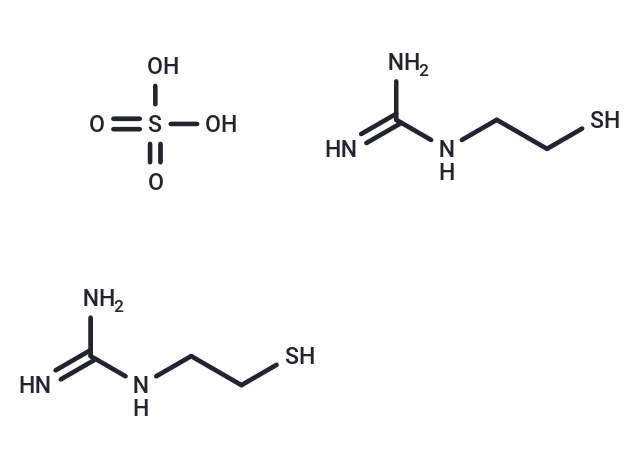
MEG hemisulfate
CAS No. 3979-00-8
MEG hemisulfate( —— )
Catalog No. M33774 CAS No. 3979-00-8
MEG hemisulfate (Mercaptoethylguanidine hemisulfate) acts as a highly potent and selective suppressor of inducible NO synthase (iNOS), demonstrating EC50 values of 11.5 μM for iNOS, 110 μM for ecNOS, and 60 μM for bNOS in tissue homogenates.
Purity : >98% (HPLC)
 COA
Datasheet
HNMR
HPLC
MSDS
Handing Instructions
COA
Datasheet
HNMR
HPLC
MSDS
Handing Instructions
| Size | Price / USD | Stock | Quantity |
| 1 mL x 10 mM in DMSO | 55 | In Stock |


|
| 5MG | 45 | In Stock |
|
| 10MG | 65 | In Stock |
|
| 100MG | Get Quote | In Stock |
|
| 200MG | Get Quote | In Stock |
|
| 500MG | Get Quote | In Stock |
|
| 1G | Get Quote | In Stock |
|
Biological Information
-
Product NameMEG hemisulfate
-
NoteResearch use only, not for human use.
-
Brief DescriptionMEG hemisulfate (Mercaptoethylguanidine hemisulfate) acts as a highly potent and selective suppressor of inducible NO synthase (iNOS), demonstrating EC50 values of 11.5 μM for iNOS, 110 μM for ecNOS, and 60 μM for bNOS in tissue homogenates.
-
DescriptionMEG (Mercaptoethylguanidine) hemisulfate is a potent and selective inhibitor of the inducible NO synthase (iNOS), with EC50s of 11.5, 110, and 60 μM for iNOS, ecNOS, and bNOS respectively in tissue homogenates. MEG hemisulfate is also a potent scavenger of peroxynitrite and inhibits peroxynitrite-induced oxidative processes. MEG hemisulfate has a protective effect in many experimental models of inflammation, including ischemia/reperfusion injury, periodontitis, hemorrhagic shock, inflammatory bowel disease, and endotoxic and septic shock.
-
In VitroMEG (0.1-1000 μM; 18 h) reduces nitrite accumulation in the supernatant of cultured J774.2 macrophages activated with LPS (10 μg/mL) and INF (50 μg/mL). MEG inhibits iNOS activity in homogenates of lungs taken from LPS-treated rats.MEG (1 μM-3 mM; 3 min) dose-dependently inhibits the peroxynitrite-induced oxidation of cytochrome c2+ and hydroxylation of benzoate.MEG (1-300 μM) inhibits the suppression of mitochondrial respiration and DNA single strand breakage in response to peroxynitrite in J774 cells.MEG (300 μM; 30 min) inhibits the suppression of vascular contractility in response to peroxynitrite in thoracic aortic rings.
-
In VivoMEG (10 mg/kg; i.p. for 5 d) attenuates the degree of lipid peroxidation, protein oxidation, and peroxynitrites level and ameliorated the decrease of antioxidant enzymes activities in the esophagus of rats subjected to caustic burn injury.MEG (30-60 mg/kg; a single i.p.) decreases mean arterial blood pressure (MAP) of normal rats.MEG (10 mg/kg; a single i.p.) improves the renal dysfunction and tissue injury induced by ischemia/reperfusion (I/R) of rat kidney.Animal Model:Sprague-Dawley rats (200-250 g) were injured the esophagus Dosage:10 mg/kg Administration:I.p. for 5 days Result:Reduced the stenosis index (SI) and the histopathologic damage score.Decreased the malondialdehyde and protein carbonyl content and increased the activities of superoxide dismutase and glutathione peroxidase.
-
Synonyms——
-
PathwayImmunology/Inflammation
-
TargetNOS
-
RecptorNOS
-
Research Area——
-
Indication——
Chemical Information
-
CAS Number3979-00-8
-
Formula Weight336.44
-
Molecular FormulaC6H20N6O4S3
-
Purity>98% (HPLC)
-
Solubility——
-
SMILESO=S(O)(O)=O.N=C(NCCS)N.N=C(NCCS)N
-
Chemical Name——
Shipping & Storage Information
-
Storage(-20℃)
-
ShippingWith Ice Pack
-
Stability≥ 2 years
Reference
1. Southan GJ, et, al. Spontaneous rearrangement of aminoalkylisothioureas into mercaptoalkylguanidines, a novel class of nitric oxide synthase inhibitors with selectivity towards the inducible isoform. Br J Pharmacol. 1996 Feb;117(4):619-32.?
molnova catalog



related products
-
3-Bromo-7-Nitroindaz...
3-Bromo-7-Nitroindazole is a more potent inhibitor of nNOS than 7-nitroindazole in vitro.
-
Regaloside B
Regaloside B can inhibit the expression of iNOS and COX-2. Regaloside B is a phenylpropanoid isolated from Lilium longiflorum.It?has anti-inflammatory activity.
-
NOS-IN-1?
2-Imino-4-methylpiperidine is a potent, general NOS inhibitor.
