


 Cart
Cart
 sales@molnova.com


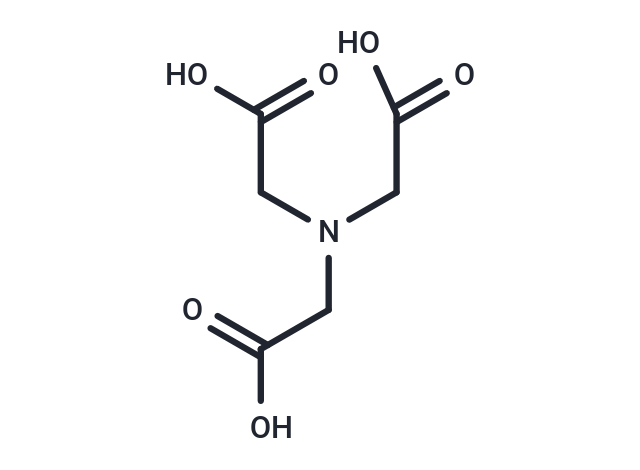
Nitrilotriacetic acid
CAS No. 139-13-9
Nitrilotriacetic acid( —— )
Catalog No. M33692 CAS No. 139-13-9
Nitrilotriacetic acid (Nitriloacetate) is a chelator that tracks and enriches His-tagged proteins in living cells by reacting with divalent metal ions-mediated 6His tagging.
Purity : >98% (HPLC)
 COA
Datasheet
HNMR
HPLC
MSDS
Handing Instructions
COA
Datasheet
HNMR
HPLC
MSDS
Handing Instructions
| Size | Price / USD | Stock | Quantity |
| 100MG | Get Quote | In Stock |


|
| 200MG | Get Quote | In Stock |
|
| 500MG | Get Quote | In Stock |
|
| 1G | 28 | In Stock |
|
Biological Information
-
Product NameNitrilotriacetic acid
-
NoteResearch use only, not for human use.
-
Brief DescriptionNitrilotriacetic acid (Nitriloacetate) is a chelator that tracks and enriches His-tagged proteins in living cells by reacting with divalent metal ions-mediated 6His tagging.
-
DescriptionNitrilotriacetic acid is an aminotricarboxylic acid. Nitrilotriacetic acid can be used as a chelating agent, forming coordination compounds with metal ions.
-
In Vitro——
-
In Vivo——
-
Synonyms——
-
PathwayOthers
-
TargetOther Targets
-
RecptorOthers
-
Research Area——
-
Indication——
Chemical Information
-
CAS Number139-13-9
-
Formula Weight191.14
-
Molecular FormulaC6H9NO6
-
Purity>98% (HPLC)
-
Solubility——
-
SMILESO=C(O)CN(CC(=O)O)CC(=O)O
-
Chemical Name——
Shipping & Storage Information
-
Storage(-20℃)
-
ShippingWith Ice Pack
-
Stability≥ 2 years
Reference
1. Anderson RL, et al. A review of the environmental and mammalian toxicology of nitrilotriacetic acid. Crit Rev Toxicol. 1985;15(1):1-102.?
molnova catalog



related products
-
Monascorubrin
Monascorubrin is purified from the mycelium of Monascus purpureus. Monascorubrin has significant antibiotic activities against Bacillus subtilis and Candida pseudotropicalis.
-
Calcitonin Gene Rela...
Calcitonin Gene Related Peptide II, rat
-
3-Methyl-2-oxobutano...
alpha-Ketoisovaleric acid is an abnormal metabolite that arises from the incomplete breakdown of branched-chain amino acids. alpha-Ketoisovaleric acid is a neurotoxin an acidogen and a metabotoxin.
