


 Cart
Cart
 sales@molnova.com


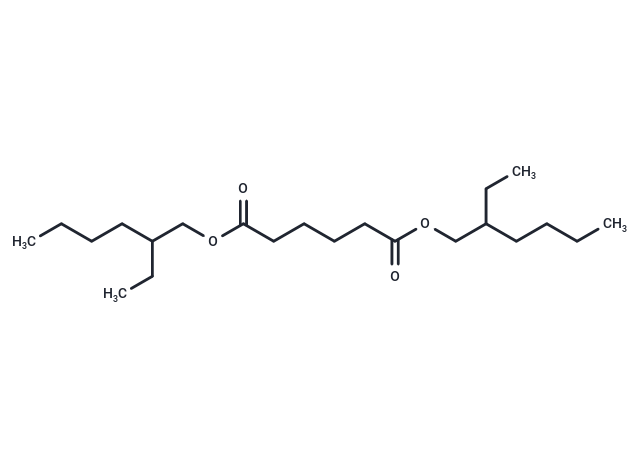
Bis(2-ethylhexyl)hexanedioate
CAS No. 103-23-1
Bis(2-ethylhexyl)hexanedioate( —— )
Catalog No. M33653 CAS No. 103-23-1
Bis(2-ethylhexyl)hexanedioate (NSC 56775) is a diester produced by the formal condensation of the carboxyl group of adipic acid with 2-ethylhexan-1-ol, and is used as a plasticizer in the preparation of various polymers.
Purity : >98% (HPLC)
 COA
Datasheet
HNMR
HPLC
MSDS
Handing Instructions
COA
Datasheet
HNMR
HPLC
MSDS
Handing Instructions
| Size | Price / USD | Stock | Quantity |
| 5MG | 686 | In Stock |


|
| 10MG | 938 | In Stock |
|
| 25MG | 1444 | In Stock |
|
| 50MG | 1841 | In Stock |
|
| 100MG | 2567 | In Stock |
|
| 200MG | 3460 | In Stock |
|
| 500MG | Get Quote | In Stock |
|
| 1G | Get Quote | In Stock |
|
Biological Information
-
Product NameBis(2-ethylhexyl)hexanedioate
-
NoteResearch use only, not for human use.
-
Brief DescriptionBis(2-ethylhexyl)hexanedioate (NSC 56775) is a diester produced by the formal condensation of the carboxyl group of adipic acid with 2-ethylhexan-1-ol, and is used as a plasticizer in the preparation of various polymers.
-
DescriptionBis(2-ethylhexyl)hexanedioate (NSC 56775) is a diester produced by the formal condensation of the carboxyl group of adipic acid with 2-ethylhexan-1-ol, and is used as a plasticizer in the preparation of various polymers.
-
In Vitro——
-
In Vivo——
-
Synonyms——
-
PathwayOthers
-
TargetOther Targets
-
RecptorOthers
-
Research Area——
-
Indication——
Chemical Information
-
CAS Number103-23-1
-
Formula Weight370.57
-
Molecular FormulaC22H42O4
-
Purity>98% (HPLC)
-
Solubility——
-
SMILESO=C(OCC(CC)CCCC)CCCCC(=O)OCC(CC)CCCC
-
Chemical Name——
Shipping & Storage Information
-
Storage(-20℃)
-
ShippingWith Ice Pack
-
Stability≥ 2 years
Reference
molnova catalog



related products
-
L-5-BromoTryptophan
5BrW is an analog of the tryptophan (Trp) effector and inhibits the gelation of hemoglobin S.
-
CW069
CW069(IC50=75 μM), an allosteric selective inhibitor of microtubule motor protein HSET, exhibits remarkable specificity over KSP.
-
2-Propenoic acid, 2-...
Anticancer agent 96 (Compound 4) is an anticancer agent that shows cytotoxic activities against human cancer cells.
