


 Cart
Cart
 sales@molnova.com


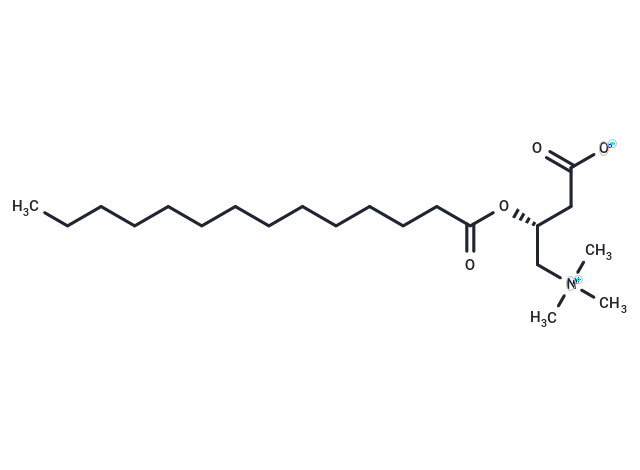
Tetradecanoylcarnitine
CAS No. 25597-07-3
Tetradecanoylcarnitine( —— )
Catalog No. M33519 CAS No. 25597-07-3
Tetradecanoylcarnitine (L-Myristoylcarnitine) is an acylcarnitine involved in the beta-oxidation of long-chain fatty acids, and is a potential marker for very-long-chain coenzyme A dehydrogenase deficiency.
Purity : >98% (HPLC)
 COA
Datasheet
HNMR
HPLC
MSDS
Handing Instructions
COA
Datasheet
HNMR
HPLC
MSDS
Handing Instructions
| Size | Price / USD | Stock | Quantity |
| 1 mL x 10 mM in DMSO | 52 | In Stock |


|
| 5MG | 46 | In Stock |
|
| 10MG | 73 | In Stock |
|
| 25MG | 155 | In Stock |
|
| 50MG | 259 | In Stock |
|
| 100MG | 388 | In Stock |
|
| 200MG | Get Quote | In Stock |
|
| 500MG | Get Quote | In Stock |
|
| 1G | Get Quote | In Stock |
|
Biological Information
-
Product NameTetradecanoylcarnitine
-
NoteResearch use only, not for human use.
-
Brief DescriptionTetradecanoylcarnitine (L-Myristoylcarnitine) is an acylcarnitine involved in the beta-oxidation of long-chain fatty acids, and is a potential marker for very-long-chain coenzyme A dehydrogenase deficiency.
-
DescriptionTetradecanoylcarnitine is a human carnitine involved in β-oxidation of long-chain fatty acids.
-
In Vitro——
-
In Vivo——
-
Synonyms——
-
PathwayProteasome/Ubiquitin
-
TargetEndogenous Metabolite
-
RecptorEndogenous Metabolite
-
Research Area——
-
Indication——
Chemical Information
-
CAS Number25597-07-3
-
Formula Weight371.55
-
Molecular FormulaC21H41NO4
-
Purity>98% (HPLC)
-
SolubilityIn Vitro:?H2O : 100 mg/mL (269.14 mM; Ultrasonic) DMSO : 25 mg/mL (67.29 mM; Ultrasonic (<60°C)
-
SMILESCCCCCCCCCCCCCC(=O)O[C@H](CC([O-])=O)C[N+](C)(C)C
-
Chemical Name——
Shipping & Storage Information
-
Storage(-20℃)
-
ShippingWith Ice Pack
-
Stability≥ 2 years
Reference
molnova catalog



related products
-
PE(18:1(9Z)/0:0)
PE(18:1(9Z)/0:0) is a naturally-occurring lysophospholipid and an analog of plasmalogen lysophosphatidylethanolamine. PE(18:1(9Z)/0:0) induces transient increases in intracellular calcium in PC12 rat neuronal cells in a concentration-dependent manner.
-
5,6-Dihydroxyindole
5,6-Dihydroxyindole (Dopamine lutine) is a melanin precursor and has a broad-spectrum antibacterial, antiviral, antifungal, antiparasitic activity.
-
p-Cresyl sulfate pot...
p-Methylphenyl potassium sulfate is a prototype protein-bound uremic toxin derived from the metabolites of tyrosine and phenylalanine through liver.
