


 Cart
Cart
 sales@molnova.com


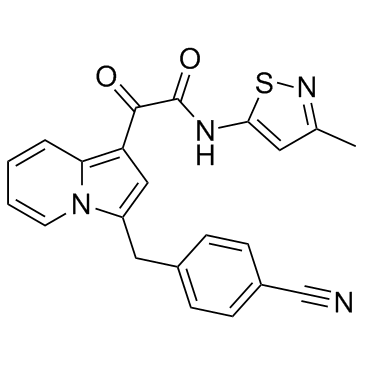
Rosabulin
CAS No. 501948-05-6
Rosabulin( —— )
Catalog No. M33484 CAS No. 501948-05-6
v Rosabulin (STA 5312) is an orally active microtubule inhibitor with potency. Rosabulin inhibits microtubule assembly and has broad-spectrum antitumor activity.
Purity : >98% (HPLC)
 COA
Datasheet
HNMR
HPLC
MSDS
Handing Instructions
COA
Datasheet
HNMR
HPLC
MSDS
Handing Instructions
| Size | Price / USD | Stock | Quantity |
| 1 mL x 10 mM in DMSO | 265 | In Stock |


|
| 5MG | 242 | In Stock |
|
| 10MG | 364 | In Stock |
|
| 25MG | 658 | In Stock |
|
| 50MG | 918 | In Stock |
|
| 100MG | 1386 | In Stock |
|
| 200MG | Get Quote | In Stock |
|
| 500MG | Get Quote | In Stock |
|
| 1G | Get Quote | In Stock |
|
Biological Information
-
Product NameRosabulin
-
NoteResearch use only, not for human use.
-
Brief Descriptionv Rosabulin (STA 5312) is an orally active microtubule inhibitor with potency. Rosabulin inhibits microtubule assembly and has broad-spectrum antitumor activity.
-
DescriptionRosabulin (STA 5312) is a potent and orally active microtubule inhibitor that inhibits microtubule assembly. Rosabulin has broad-spectrum anti-tumor activity.
-
In VitroRosabulin (STA 5312) demonstrates substantial anti-proliferative activity against a wide range of cancer cell linesin vitro, including hematologic and solid tumor cell lines of various origins (e.g. leukemia, lymphoma, breast, colon, uterine), with IC50 values extending down into the nanomolar range. Cell lines with multi-drug resistant (MDR) phenotypes are similarly sensitive to Rosabulin. The mechanism of action for Rosabulin is inhibition of microtubule assembly and subsequent arrest of the cell cycle.
-
In VivoWhen dosed orally or intravenously, Rosabulin (STA 5312) has shown in vivo activity in several murine tumors as well as human tumor xenograft models, including drug resistant tumors.
-
Synonyms——
-
PathwayOthers
-
TargetOther Targets
-
RecptorMicrotubule Associated
-
Research Area——
-
Indication——
Chemical Information
-
CAS Number501948-05-6
-
Formula Weight400.45
-
Molecular FormulaC22H16N4O2S
-
Purity>98% (HPLC)
-
SolubilityIn Vitro:?DMSO : 50 mg/mL (124.86 mM; Ultrasonic )
-
SMILESCc1cc(NC(=O)C(=O)c2cc(Cc3ccc(cc3)C#N)n3ccccc23)sn1
-
Chemical Name——
Shipping & Storage Information
-
Storage(-20℃)
-
ShippingWith Ice Pack
-
Stability≥ 2 years
Reference
1. Keizo Koya,et al. STA-5312, a novel tubulin inhibitor, demonstrates the anti-cancer activity against chemotherapy-resistant cancers. Cancer Res, Volume 45, 2004.
molnova catalog



related products
-
Hydroxyethyl cellulo...
Hydroxyethyl cellulose is a nonionic water-soluble modified cellulose polymer used as a thickener in water-soluble cosmetics and personal care formulations.
-
Sultosilic acid pipe...
Sultosilic acid piperazine salt (A-585) is a novel lipid-lowering compound that can be used to study type IIb familial combined hyperlipidemia.
-
5-Methylcytosine
5-Methylcytosine is a methylated nucleotide base found in eukaryotic DNA. In animals the DNA methylation of cytosine to form 5-methylcytosine is found primarily in the palindromic sequence CpG. In plants the methylated sequence is CpNpGp where N can be any base. 5-Methylcytosine is an epigenetic modification formed by the action of DNA methyltransferases.
