


 Cart
Cart
 sales@molnova.com


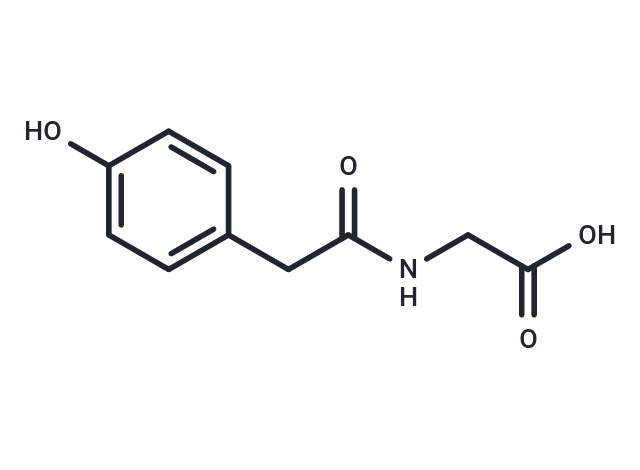
Hydroxyphenylacetylglycine
CAS No. 28116-23-6
Hydroxyphenylacetylglycine( —— )
Catalog No. M33221 CAS No. 28116-23-6
Hydroxyphenylacetylglycine (p-Hydroxyphenylacetylglycine) is an endogenous human metabolite.
Purity : >98% (HPLC)
 COA
Datasheet
HNMR
HPLC
MSDS
Handing Instructions
COA
Datasheet
HNMR
HPLC
MSDS
Handing Instructions
| Size | Price / USD | Stock | Quantity |
| 1 mL x 10 mM in DMSO | 29 | In Stock |


|
| 10MG | 37 | In Stock |
|
| 25MG | 65 | In Stock |
|
| 50MG | 105 | In Stock |
|
| 100MG | 154 | In Stock |
|
| 200MG | Get Quote | In Stock |
|
| 500MG | 392 | In Stock |
|
| 1G | Get Quote | In Stock |
|
Biological Information
-
Product NameHydroxyphenylacetylglycine
-
NoteResearch use only, not for human use.
-
Brief DescriptionHydroxyphenylacetylglycine (p-Hydroxyphenylacetylglycine) is an endogenous human metabolite.
-
DescriptionHydroxyphenylacetylglycine is an acyl glycine, and an endogenous human metabolite.
-
In Vitro——
-
In Vivo——
-
Synonyms——
-
PathwayProteasome/Ubiquitin
-
TargetEndogenous Metabolite
-
RecptorEndogenous Metabolite
-
Research Area——
-
Indication——
Chemical Information
-
CAS Number28116-23-6
-
Formula Weight209.2
-
Molecular FormulaC10H11NO4
-
Purity>98% (HPLC)
-
SolubilityIn Vitro:?DMSO : 100 mg/mL (478.01 mM; Ultrasonic )
-
SMILESC(C(NCC(O)=O)=O)C1=CC=C(O)C=C1
-
Chemical Name——
Shipping & Storage Information
-
Storage(-20℃)
-
ShippingWith Ice Pack
-
Stability≥ 2 years
Reference
1. Stanislaus A, et al. Development of an isotope labeling ultra-high performance liquid chromatography mass spectrometric method for quantification of acylglycines in human urine. Anal Chim Acta. 2012 Oct 31;750:161-72.?
molnova catalog



related products
-
D-Mannose
D-Mannose is a carbohydrate which plays an important role in human metabolism especially in the glycosylation of specific proteins.
-
9AzNue5Ac
9AzNue5Ac is a Neu5Ac analog that is metabolized in living cells and in mice.9AzNue5Ac binds to salivary glycans.
-
Octadecanedioic acid
Octadecanedioic acid is an endogenous metabolite, is a long-chain dicarboxylic acid.
