


 Cart
Cart
 sales@molnova.com


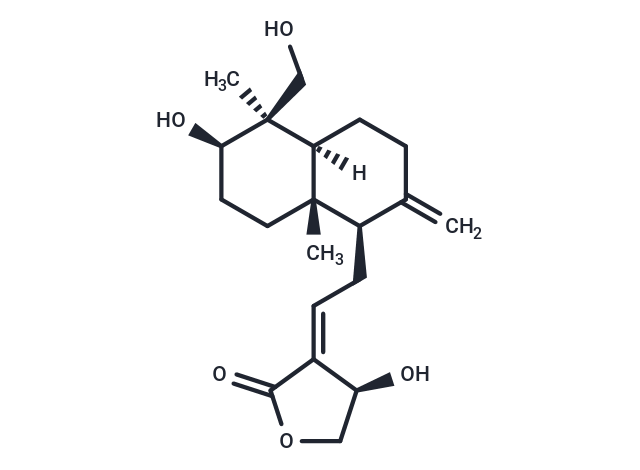
14-Epiandrographolide
CAS No. 142037-79-4
14-Epiandrographolide( —— )
Catalog No. M33083 CAS No. 142037-79-4
14-Epiandrographolide is a compound derived from the above-ground parts of Andrographis paniculata that induces cell differentiation and can be used in the study of multiple sclerosis.
Purity : >98% (HPLC)
 COA
Datasheet
HNMR
HPLC
MSDS
Handing Instructions
COA
Datasheet
HNMR
HPLC
MSDS
Handing Instructions
| Size | Price / USD | Stock | Quantity |
| 5MG | 459 | In Stock |


|
| 10MG | 657 | In Stock |
|
| 25MG | 1026 | In Stock |
|
| 50MG | 1386 | In Stock |
|
| 100MG | 1832 | In Stock |
|
| 200MG | Get Quote | In Stock |
|
| 500MG | Get Quote | In Stock |
|
| 1G | Get Quote | In Stock |
|
Biological Information
-
Product Name14-Epiandrographolide
-
NoteResearch use only, not for human use.
-
Brief Description14-Epiandrographolide is a compound derived from the above-ground parts of Andrographis paniculata that induces cell differentiation and can be used in the study of multiple sclerosis.
-
Description14-Epiandrographolide is a compound derived from the above-ground parts of Andrographis paniculata that induces cell differentiation and can be used in the study of multiple sclerosis.
-
In Vitro——
-
In Vivo——
-
Synonyms——
-
PathwayOthers
-
TargetOther Targets
-
RecptorOthers
-
Research Area——
-
Indication——
Chemical Information
-
CAS Number142037-79-4
-
Formula Weight350.45
-
Molecular FormulaC20H30O5
-
Purity>98% (HPLC)
-
Solubility——
-
SMILESC[C@]12[C@@]([C@@](CO)(C)[C@H](O)CC1)(CCC(=C)[C@H]2C/C=C/3\[C@@H](O)COC3=O)[H]
-
Chemical Name——
Shipping & Storage Information
-
Storage(-20℃)
-
ShippingWith Ice Pack
-
Stability≥ 2 years
Reference
molnova catalog



related products
-
Moexipril HCl
Moexipril HCl is a potent orally active nonsulfhydrylangiotensin converting enzyme (ACE)inhibitor, used for the treatment of hypertension and congestive heart failure.
-
[Tyr0]-Stresscopin (...
[Tyr0]-Stresscopin (human)
-
8-Azabicyclo-3.2.1-o...
Reference standards.
