


 Cart
Cart
 sales@molnova.com


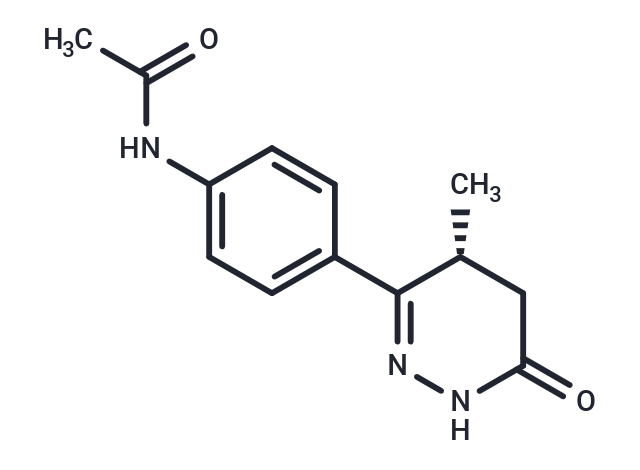
OR-1896
CAS No. 220246-81-1
OR-1896( —— )
Catalog No. M33045 CAS No. 220246-81-1
OR-1896 is the active metabolite of Levosimendan, a highly specific phosphodiesterase (PDE III) inhibitor, a vasodilator with partial anti-inflammatory properties that produces vasodilation in different types of blood vessels through activation of ATP-sensitive (KATP) and other potassium channels.
Purity : >98% (HPLC)
 COA
Datasheet
HNMR
HPLC
MSDS
Handing Instructions
COA
Datasheet
HNMR
HPLC
MSDS
Handing Instructions
| Size | Price / USD | Stock | Quantity |
| 1 mL x 10 mM in DMSO | 218 | In Stock |


|
| 5MG | 198 | In Stock |
|
| 10MG | 326 | In Stock |
|
| 25MG | 657 | In Stock |
|
| 50MG | 1014 | In Stock |
|
| 100MG | 1376 | In Stock |
|
| 200MG | 1841 | In Stock |
|
| 500MG | Get Quote | In Stock |
|
| 1G | Get Quote | In Stock |
|
Biological Information
-
Product NameOR-1896
-
NoteResearch use only, not for human use.
-
Brief DescriptionOR-1896 is the active metabolite of Levosimendan, a highly specific phosphodiesterase (PDE III) inhibitor, a vasodilator with partial anti-inflammatory properties that produces vasodilation in different types of blood vessels through activation of ATP-sensitive (KATP) and other potassium channels.
-
DescriptionOR-1896 is an active long-lived metabolite of Levosimendan. OR-1896 is a highly selective phosphodiesterase (PDE) III isoform inhibitor and a powerful vasodilator. OR-1896 can open ATP-sensitive K+ channels and has Ca2+-sensitizing effect. OR-1896 mitigates cardiomyocyte apoptosis, cardiac remodeling and myocardial inflammation.
-
In VitroThere are many evidences has accumulated and revealed a variety of beneficial pleiotropic effects OR-1896. OR-1896 evokes prominent vasodilatory responses, activation of ATP-sensitive sarcolemmal K+ channels of smooth muscle cells appears as a powerful vasodilator mechanism. Additionally, activation of ATP-sensitive K+ channels in the mitochondria potentially extends the range of cellular actions towards the modulation of mitochondrial ATP production and implicates a pharmacological mechanism for cardioprotection.
-
In VivoDuring the metabolism of Levosimendan approximately 5% of the drug is converted to the metabolite OR-1855 in the large intestine, and then acetylated in the liver to form the active metabolite OR-1896. Binding to plasma proteins is 98% for Levosimendan but only 40% for OR-1896. Unlike Levosimendan, which has an elimination half-life of 1-1.5 h, the half-life of OR-1896 is about 75 to 80 h allowing cardiovascular effects to persist up to 7 to 9 days after discontinuation of a 24-hour infusion of levosimendan. The pharmacokinetic of the parent drug is unaltered in subjects with severe renal impairment or with moderate hepatic impairment, whereas the elimination of its metabolites (OR-1896) can be prolonged.
-
Synonyms——
-
PathwayCell Cycle/DNA Damage
-
TargetPotassium Channel
-
RecptorPotassium Channel | PDE
-
Research Area——
-
Indication——
Chemical Information
-
CAS Number220246-81-1
-
Formula Weight245.28
-
Molecular FormulaC13H15N3O2
-
Purity>98% (HPLC)
-
SolubilityIn Vitro:?DMSO : 62.5 mg/mL (254.81 mM; Ultrasonic )
-
SMILESC[C@@H]1CC(=O)NN=C1c1ccc(NC(C)=O)cc1
-
Chemical Name——
Shipping & Storage Information
-
Storage(-20℃)
-
ShippingWith Ice Pack
-
Stability≥ 2 years
Reference
1. Papp, Z, et al., Levosimendan: molecular mechanisms and clinical implications: consensus of experts on the mechanisms of action of levosimendan. Int J Cardiol. 2012 Aug 23;159(2):82-7.?
molnova catalog



related products
-
ML402
ML402 is an activator of TREK-1 and TREK-2 with EC50s of 13.7 μM and 5.9 μM.
-
Hexachlorophene
Hexachlorophene(Hexachlorofen) is a potent KCNQ1/KCNE1 potassium channel activator with EC50 of 4.61 ± 1.29 μM; also is an inhibitor of Wnt/beta-catenin signaling.
-
ASP 2905
A novel potent, selective, orally bioavailable inhibitor of voltage-gated potassium channel KCNH3 with IC50 of 9.0 nM.
