


 Cart
Cart
 sales@molnova.com


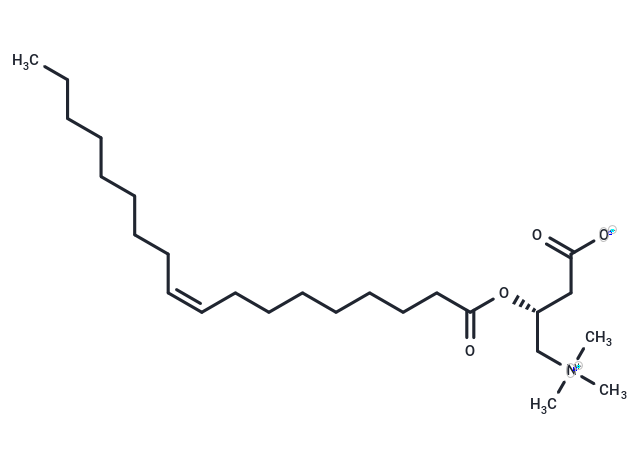
Oleoylcarnitine
CAS No. 38677-66-6
Oleoylcarnitine( —— )
Catalog No. M33043 CAS No. 38677-66-6
Oleoylcarnitine (Oleoyl-L-carnitine) inhibits adenine nucleotide translocase (AdNT) activity with an ic50 of 14 μM.Oleoylcarnitine is an important indicator of neurodegeneration.
Purity : >98% (HPLC)
 COA
Datasheet
HNMR
HPLC
MSDS
Handing Instructions
COA
Datasheet
HNMR
HPLC
MSDS
Handing Instructions
| Size | Price / USD | Stock | Quantity |
| 5MG | 128 | In Stock |


|
| 10MG | 186 | In Stock |
|
| 25MG | 319 | In Stock |
|
| 100MG | Get Quote | In Stock |
|
| 200MG | Get Quote | In Stock |
|
| 500MG | Get Quote | In Stock |
|
| 1G | Get Quote | In Stock |
|
Biological Information
-
Product NameOleoylcarnitine
-
NoteResearch use only, not for human use.
-
Brief DescriptionOleoylcarnitine (Oleoyl-L-carnitine) inhibits adenine nucleotide translocase (AdNT) activity with an ic50 of 14 μM.Oleoylcarnitine is an important indicator of neurodegeneration.
-
DescriptionOleoylcarnitine, the metabolite which accumulates through suppression of fatty acid β-oxidation, can enhance hepatocarcinogenesis via STAT3 activation.
-
In VitroOleoylcarnitine (AC18:1) (5, 25, 50 μM; 24, 48 hours) concentration significantly increases in the Dih10 cells with stable CPT2 knock down.Oleoylcarnitine (5 μM, 24 hours) contributes directly to hepatocarcinogenesis by conferring stem cell properties to cancer cells through STAT3 activation.Cell Viability Assay Cell Line:Dih 10 cells, HCC cells Concentration:5, 25, 50 μM Incubation Time:24, 48 hours Result:Enhanced the self-renewal of HCC cells through STAT3 activation.
-
In VivoOleoylcarnitine (AC18:1) accumulates markedly in obesity-driven HCC tissues of mice.Animal Model:MUP-uPA and PIK3CA Tg mice.Dosage:Administration:High-fat diet (HFD) for miceResult:Accumulated in HCC tissues and in the serum of HFD-fed mice.
-
Synonyms——
-
PathwayProteasome/Ubiquitin
-
TargetEndogenous Metabolite
-
RecptorEndogenous Metabolite
-
Research Area——
-
Indication——
Chemical Information
-
CAS Number38677-66-6
-
Formula Weight425.64
-
Molecular FormulaC25H47NO4
-
Purity>98% (HPLC)
-
SolubilityIn Vitro:?DMSO : 100 mg/mL (234.94 mM; Ultrasonic (<60°C)
-
SMILESCCCCCCCC\C=C/CCCCCCCC(=O)O[C@H](CC([O-])=O)C[N+](C)(C)C
-
Chemical Name——
Shipping & Storage Information
-
Storage(-20℃)
-
ShippingWith Ice Pack
-
Stability≥ 2 years
Reference
1. Fujiwara N, et al. CPT2 downregulation adapts HCC to lipid-rich environment and promotes carcinogenesis via acylcarnitine accumulation in obesity. Gut. 2018 Aug;67(8):1493-1504.?
molnova catalog



related products
-
Alanylphenylalanine
Alanylphenylalanine (Ala-phe) is a compound isolated from the brainstem of calves.
-
N-Lactoyl-Phenylalan...
N-Lactoyl-Phenylalanine (Lac-Phe) is a peptide coupling of lactic acid and phenylalanine, one of the metabolites in acute exercise, which can be used in the study of obesity and metabolism-related diseases.
-
N1-Acetylspermidine ...
N1-Acetylspermidine hydrochloride, an acetyl derivative of spermidine, serves as a substrate for polyamine oxidase and selectively elevates its levels in human colorectal adenocarcinomas.
